
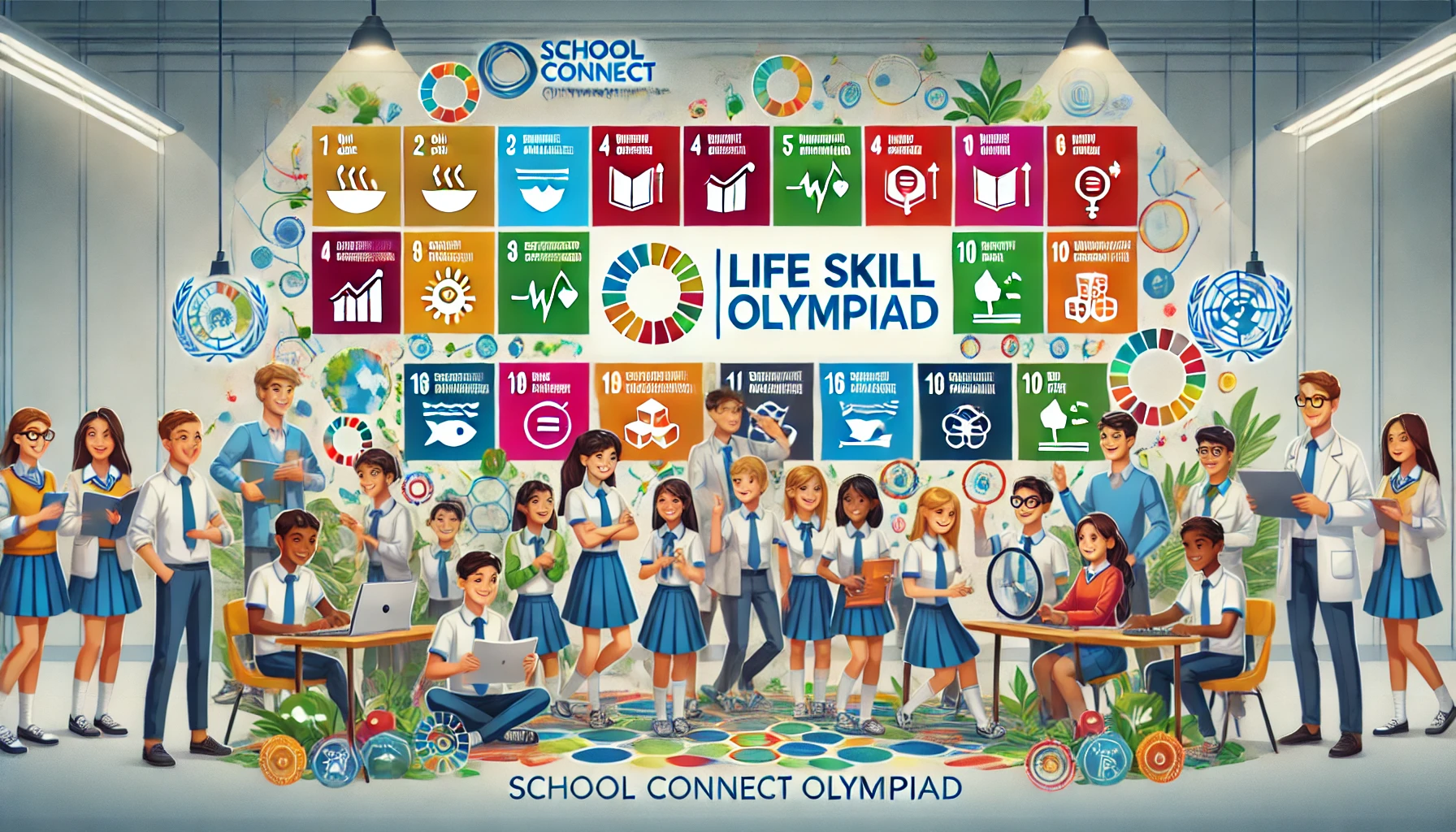
A child’s first lessons about the world often begin with small actions: washing hands, saying thank you, listening to a friend and caring for plants. The Class 1 Life Skills Olympiad helps children understand these useful habits through stories, play and everyday choices. This guide follows the School Connect Class 1 Life Skills learning chapters, connects them with the United Nations Sustainable Development Goals (SDGs), and includes original questions and parent-friendly activities that children can enjoy at their own pace.

Why should Class 1 children learn life skills?
Life skills are not only for examinations. A child who learns to express a feeling, ask for help, respect another person’s tradition and use water thoughtfully is practising abilities needed at home, in school and in the community.
- Healthy habits: practise handwashing, regular tooth brushing, rest, safe movement and asking adults for help.
- Kind communication: listen, say please and thank you, share needs and respect another person’s turn to speak.
- Emotional understanding: recognise feelings like sadness, happiness or worry, and respond with care.
- Responsibility: tidy up shared toys, look after learning materials and help with safe age-appropriate tasks.
- Respect and belonging: learn that families may have different languages, celebrations and beliefs.
- Care for nature: use water thoughtfully, keep spaces clean and care for living plants.
What are the Sustainable Development Goals (SDGs)?
The UN Sustainable Development Goals are 17 shared goals for a healthier, fairer and more sustainable world by 2030. Young children do not need to memorise all their numbers. They can understand a few through familiar activities.
- SDG 3 — Good Health and Well-being: wash hands with soap, stay active and practise safe daily routines.
- SDG 4 — Quality Education: include classmates, listen to stories and help everyone have opportunities to learn.
- SDG 5 — Gender Equality: share classroom jobs fairly; any child can help tidy up or lead a game.
- SDG 6 — Clean Water and Sanitation: turn off a tap when it is not needed and use clean water thoughtfully.
- SDG 13 — Climate Action: care for the environment through small, sensible habits.
- SDG 16 — Peace, Justice and Strong Institutions: solve disagreements peacefully, be fair and treat others respectfully.
The eight Class 1 Life Skills Olympiad learning chapters
School Connect’s Class 1 Life Skills subject page groups its current lessons into eight chapters. These connect with the five foundational life-skills themes of healthy habits, communication, emotional understanding, gratitude and environmental care.
1. Festivals and celebrations
Explore how families and communities mark special occasions. School Connect’s chapters introduce Holi, Diwali, Rakshabandhan, Eid ul-Fitr and different new-year celebrations including Baisakhi, Gudi Padwa and Ugadi. Ask children: “What is a kind way to learn about a friend’s celebration?” Encourage curiosity without assuming every child celebrates the same way.
2. Places of worship and respect for others
Learn that people may visit a gurdwara, temple, mosque or church, and that some families practise beliefs in other ways or follow no religion. Children can recognise different buildings and practise respecting other people’s choices. The lesson is kindness and understanding, not deciding whose belief is best.
3. Good habits
Practise handwashing, dental care, safe play, tidy spaces and simple routines. UNICEF’s handwashing guidance recommends rubbing hands with soap for at least 20 seconds, including between fingers and around nails. Adults can demonstrate and help children remember to wash before food and after using the toilet.
4. Learning from Panchatantra and Jataka stories
The SCO chapters include The Stork and the Crab (Panchatantra) and The Golden Mallard (Jataka). Read a child-friendly retelling with an adult and ask: “What happened?”, “Was the choice fair?” and “What could the characters do differently?” Different retellings may emphasise different lessons; use the story to encourage thinking rather than memorising one rigid moral.
5. Gratitude and appreciation
Practise thanking caregivers, friends, teachers and school helpers. A short “gratitude circle” works well: each child names one helpful action they noticed. Gratitude should be sincere, not forced.
6. Our mentors
A mentor is someone who helps us learn or make a good choice. Children might name a teacher, caregiver, coach, grandparent or trusted community helper. Ask what the mentor teaches and how the child can practise that skill.
7. The five elements and care for the world
The SCO syllabus introduces earth, air, water, fire and space through a cultural and reflective theme. Connect this lesson with the natural world: earth supports plant life, air surrounds us, and water is needed for many everyday activities. Fire should be treated as a safety topic—young children should never experiment with flames. Discuss the five-element idea as a traditional way of thinking rather than a replacement for modern science.
8. Yoga, movement and caring for our bodies
Practise age-appropriate stretching, balance, walking and calm breathing under adult guidance. Children should not be pushed into difficult postures or told that one activity cures illnesses. The aim is comfort, safe movement and enjoyment.
Watch one short video: Why is clean water important?
The following brief animation from UN Vienna introduces SDG 6 — Clean Water and Sanitation for young learners. Use it as a starting point for a real activity: turn off the tap while brushing teeth and talk about why water should not be wasted.
Video: UN Vienna — SDG 6: Clean Water and Sanitation. Watch on YouTube if the player does not load. Talk together afterwards about when we use clean water and why taps should not be left running.
Six simple activities for home or the classroom
- Handwashing sequence: draw or arrange cards for wet hands, use soap, scrub, rinse and dry. An adult can demonstrate each step.
- Feelings faces: draw happy, sad, worried and excited faces. Ask what kind words could help someone who feels worried.
- Thank-you circle: invite each child to name a person who helped them this week and explain how they felt.
- Shared classroom jobs: let children take turns arranging books or watering a plant with appropriate supervision.
- Story choices: after a Panchatantra or Jataka story, ask children what a kind character might do next.
- Water-wise habit: check that taps are closed after use and remind friends gently; do not handle hot water or heavy containers without adult help.
20 original Class 1 Life Skills Olympiad questions with answers
Read each short question aloud if needed. These are new practice situations for learning and discussion, with simple choices and explanations. Children can also point to an answer or act it out with an adult.
Question 1 — Healthy habits
When should we wash our hands with soap?
A. Before eating and after using the toilet B. Only on weekends C. Never D. Only when visitors arrive
Answer: A. Before eating and after using the toilet. Washing hands with soap before food and after using the toilet helps keep germs from spreading.
Question 2 — Good habits
Which is a healthy everyday habit?
A. Skipping sleep every night B. Brushing our teeth regularly C. Sharing a dirty toothbrush D. Leaving rubbish on the floor
Answer: B. Brushing our teeth regularly. Regular tooth brushing is part of caring for our health.
Question 3 — Safety
A child sees a broken glass on the floor. What should they do?
A. Pick up every sharp piece alone B. Run across it C. Tell a trusted adult and stay clear D. Hide it under a mat
Answer: C. Tell a trusted adult and stay clear. Broken glass can cut skin. Keep away and ask an adult to help.
Question 4 — Caring for others
A friend looks sad after losing a game. What could you say?
A. Stop talking to me B. You must never play again C. It does not matter how you feel D. Would you like to talk or play together?
Answer: D. Would you like to talk or play together?. Listening and offering company are caring responses. It is fine if a friend needs time alone.
Question 5 — Communication
What is a polite way to ask for a pencil?
A. May I borrow your pencil, please? B. Give it to me now! C. I will take it without asking. D. Your pencil is mine.
Answer: A. May I borrow your pencil, please?. Saying please and asking permission respects others.
Question 6 — Listening
During story time, what helps us understand the story?
A. Shouting over the reader B. Listening carefully C. Talking to everyone at once D. Covering our ears
Answer: B. Listening carefully. Careful listening helps us understand characters, actions and ideas.
Question 7 — Sharing
Two friends want the same colour pencil. What is a kind solution?
A. Break the pencil B. Hide it forever C. Take turns using it D. Tell them never to colour
Answer: C. Take turns using it. Taking turns allows both friends to use the pencil.
Question 8 — Responsibility
After playing with blocks, what can you do?
A. Leave all blocks where people might trip B. Throw them away C. Blame another child D. Put them back in their place
Answer: D. Put them back in their place. Tidying up helps keep shared areas organised and safe.
Question 9 — Gratitude
Someone helps you tie your shoelaces. What can you say?
A. Thank you for helping me B. Go away! C. You must always do it for me D. I did not need any help, ever
Answer: A. Thank you for helping me. Thanking someone is a friendly way to show appreciation.
Question 10 — Festivals and respect
A classmate celebrates a festival different from yours. What is respectful?
A. Laugh at their tradition B. Listen and ask polite questions if they want to share C. Tell them to stop celebrating D. Assume everyone celebrates identically
Answer: B. Listen and ask polite questions if they want to share. We can respect different customs, and classmates may share as much or as little as they wish.
Question 11 — Places in our community
Which group contains places where some people gather for worship?
A. Bus, train, car B. Book, pencil, desk C. Temple, mosque, church and gurdwara D. Rain, wind, snow
Answer: C. Temple, mosque, church and gurdwara. Different communities worship in different kinds of places. Everyone deserves respect.
Question 12 — Community helpers
Who can help keep a classroom clean?
A. Only one person every year B. Nobody C. Only visitors D. Students and adults working together
Answer: D. Students and adults working together. Shared responsibility makes a classroom more welcoming.
Question 13 — Learning from stories
A story character learns from a mistake. What could readers try?
A. Think about the lesson and make a better choice B. Repeat every mistake on purpose C. Ignore everyone’s safety D. Assume stories cannot teach us
Answer: A. Think about the lesson and make a better choice. Stories can help us discuss choices, kindness and consequences.
Question 14 — Fairness
Who should have a chance to join a classroom game?
A. Only the tallest children B. Children of different backgrounds and abilities with suitable support C. Only children with red shoes D. Only people who can run fastest
Answer: B. Children of different backgrounds and abilities with suitable support. Inclusive games can be adapted so different children can join safely.
Question 15 — Feelings
A friend says, ‘I feel nervous.’ What is a helpful response?
A. That feeling is silly B. Stop being nervous right now C. It is okay to feel nervous; would you like help? D. Never speak about feelings
Answer: C. It is okay to feel nervous; would you like help?. Naming a feeling and offering support helps a friend feel heard.
Question 16 — Nature care
A small plant’s soil is dry. What could you do?
A. Pull off all its leaves B. Place it in a locked dark cupboard C. Pour rubbish near its roots D. Ask an adult and water it appropriately
Answer: D. Ask an adult and water it appropriately. Plants need suitable water and light. An adult can help with the right amount.
Question 17 — Saving water
While brushing your teeth, the tap is running. What is a useful habit?
A. Turn off the tap while brushing B. Let water run for fun C. Open another tap too D. Wash the toothbrush for an hour
Answer: A. Turn off the tap while brushing. Turning the tap off when it is not needed saves water.
Question 18 — Reducing waste
Which is a good way to reduce classroom paper waste?
A. Throw away unused clean sheets B. Use both sides of paper when suitable C. Tear new paper just for fun D. Leave paper in the playground
Answer: B. Use both sides of paper when suitable. Using materials thoughtfully helps reduce unnecessary waste.
Question 19 — Healthy movement
Which is an age-appropriate activity that can help us stay active?
A. Staying completely still all day B. Playing close to moving traffic C. Walking, stretching or playing safely with adult guidance D. Lifting heavy weights without help
Answer: C. Walking, stretching or playing safely with adult guidance. Safe movement supports health and wellbeing.
Question 20 — Protecting safety
A stranger online asks for your home address. What should you do?
A. Send it immediately B. Post it in a public group C. Share your school password too D. Do not share it; tell a trusted adult
Answer: D. Do not share it; tell a trusted adult. Private details should be kept safe. Ask a trusted adult if a message seems unusual.
A four-week Life Skills Olympiad study plan
- Week 1 — Healthy routines: learn handwashing, safety, simple yoga or movement, and taking care of toys and books.
- Week 2 — Kindness and communication: practise greetings, listening, naming feelings and taking turns.
- Week 3 — Stories and respect: explore a cultural celebration, a place of worship, a story with a lesson and the people who help us.
- Week 4 — Nature and gentle revision: try the clean-water video activity, care for a plant and answer a few original practice questions together.
Free study materials and the Class 1 syllabus
Use the Class 1 Life Skills chapter lessons for current topics and free learning. School Connect provides free chapter-wise learning materials, linked educational videos and practice questions, which are continually being improved. Exam participation and any applicable registration fee are separate from these learning resources.
The Class 1 Life Skills 2026 syllabus resource currently shows that its downloadable PDF is coming soon. You can still begin by using the online chapter descriptions and the practice activities above. For the wider subject, the International Life Skills Olympiad page links to the examination overview and other learning routes.
Registration, exam dates and results
Families considering the Life Skills Olympiad can use the official School Connect student registration form or school registration. Check the current Class 1 eligibility, examination cycle, exam language, any required assistance, fee and local time on the registration instructions. The Class 1 page currently displays a 2 October 2026 exam slot, which has already passed; a future slot must be confirmed from the current exam schedule.
The results centre and awards information explain relevant cycle outcomes. The learning goal is to encourage healthy habits, respect and care for others; no medal, certificate or scholarship should be promised without the current organiser’s rules.
Frequently asked questions about Class 1 Life Skills
Why are life skills important for Class 1 children?
Life skills help children practise healthy routines, kindness, communication, responsibility, emotional awareness and care for their surroundings.
What is the Class 1 Life Skills Olympiad syllabus?
School Connect’s current Class 1 Life Skills learning page has eight chapter groups, including celebrations, places of worship, good habits, Panchatantra and Jataka stories, gratitude, mentors, the five elements, and yoga and exercises. Its foundational SDG themes include hygiene, communication, emotions, responsibility and environment.
What do Sustainable Development Goals mean for a young child?
The UN’s 17 global goals aim for a better future for people and the planet. A child can explore them through simple actions such as washing hands, sharing fairly, learning together and conserving water.
Must a child learn all 17 SDG numbers?
No. Begin with everyday situations and explain a few relevant ideas in simple language. Understanding kind and responsible behaviour matters more than memorising numbers.
How should families teach festivals and places of worship?
Use stories and respectful discussion. People may celebrate differently or not follow a religion. Avoid assumptions about a classmate’s beliefs.
Are the SCO chapter-wise materials free?
School Connect provides free learning materials, linked educational videos and practice questions, with continuing updates.
Is a 2026 Class 1 Life Skills syllabus PDF downloadable now?
The Class 1 Life Skills 2026 syllabus resource currently says Coming soon. The topic list is available on the main Class 1 subject page, so learning can begin now.
Are these twenty questions taken from the actual Olympiad paper?
No. They are new, age-appropriate practice questions with explanations for parents and teachers to discuss.
Does a Class 1 child need to write long answers?
Begin with oral responses, picture choices and gentle discussions. Follow the organiser’s current instructions for any examination-specific answer format.
How long should we practise each day?
Around 10–15 minutes of playful discussion or a simple routine is a sensible starting point; adjust to the child’s needs and attention.
Can international students use the Class 1 Life Skills resources?
Families can explore the online learning materials internationally, but should verify grade equivalence, exam availability, language and registration terms for their location.
Where can I find registration, dates and results?
Use the current official School Connect Life Skills exam page, student registration route and results centre, and check the relevant cycle details before making plans.
Take one small step today
Choose a short chapter from the free Class 1 Life Skills learning page, practise one caring habit and ask your child to share what they noticed. You can also explore the Life Skills Olympiad guide for Classes 1–12 and the School Connect Olympiad parent guide. Small, consistent habits help young learners grow into thoughtful and confident members of their communities.








Leave a Reply