
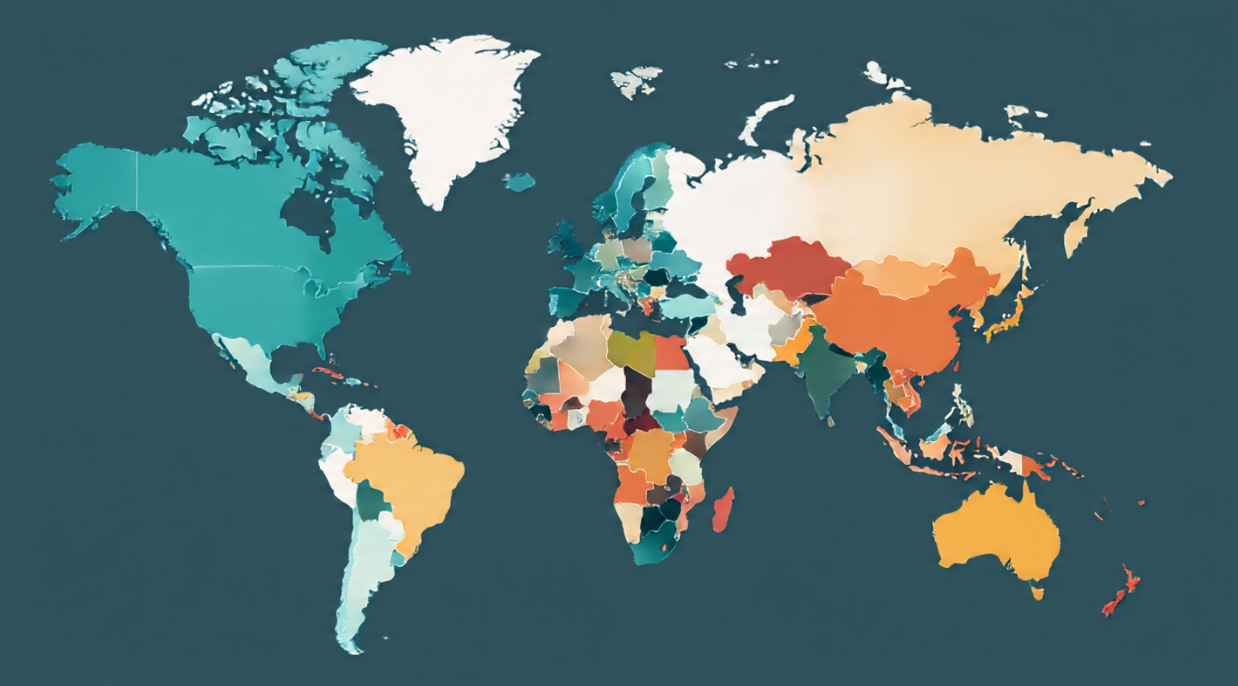
A curious student looks at a map and wonders why some rivers cross national borders. Another notices the Moon in the daytime. A third asks whether a surprising headline is true. These are excellent General Knowledge questions because they invite us to observe, read, check evidence and think for ourselves. In this guide, students in Classes 1–10 can learn about the world, explore free resources and enjoy 20 explained practice questions.

What is General Knowledge Olympiad learning?
General Knowledge connects subjects we meet every day: the natural world, maps, people, culture, science, technology, health, the environment and important events. SCO’s International General Knowledge Olympiad (IGKO) is an independent School Connect Olympiad subject. The official School Connect registration page lists it for Classes 1–10. Families can enjoy free learning first and consider exam participation separately when ready.
What children can learn at different class stages
| Classes | Learning focus | Try this activity |
|---|---|---|
| 1–2 | My family, school, plants, weather, safety, local places | Keep a three-day weather diary; name nearby helpers and their work |
| 3–4 | Directions, basic maps, animals, habitats, Earth and landmarks | Draw a route from home to school with a simple map key |
| 5–6 | Continents, rivers, solar system, science, cultures and civic habits | Locate five countries and check one interesting fact about each |
| 7–8 | World organisations, biodiversity, climate, history and news literacy | Compare two reports on the same scientific discovery |
| 9–10 | Data, environment, global connections, evidence and current affairs | Interpret a chart and investigate the original source behind its figures |
For free chapter-based learning, start from School Connect’s Class 1 General Knowledge and Class 5 General Knowledge subject pages. They introduce age-suited learning topics and lead to additional resources. Families with other classes can use the School Connect Olympiad learning platform to choose their own class and subject.
Six skills that make General Knowledge more meaningful
- Observation: Notice details in plants, weather, public spaces and simple experiments.
- Geography: Read map symbols, directions, scales and the relationship between people and places.
- Scientific curiosity: Ask why something happens, make a prediction and compare it with evidence.
- History and culture: Discover the stories behind places, art, inventions and traditions with respect for differences.
- Information literacy: Identify the publisher, date and supporting evidence behind a news claim.
- Responsible citizenship: Explore fairness, health, conservation and how individual actions can help a community.
Three real-world topics worth exploring in 2026
1. Our solar system
NASA’s planetary guide identifies eight planets orbiting the Sun. Try placing the eight names in order from the Sun, then explain why a planet is different from a star. Younger children can use drawings; older students can compare their sizes and orbital times.
2. The world’s shared heritage
A World Heritage place can be cultural, natural or mixed. UNESCO’s India page records 45 World Heritage properties in India in the 2026 snapshot. Choose one place and investigate why people preserve it. Ask: Is the value mainly historical, natural or both?
3. Learning for a better planet
The United Nations’ 17 Sustainable Development Goals encourage people to think about education, water, health, nature and communities. Pick a goal such as clean water and design one small classroom action. Measure what changes, rather than merely memorising a goal number.
20 original General Knowledge practice questions with answers
Try the questions that match your class stage. Cover the answer paragraph first, make a choice, and explain why it makes sense. Each problem is an original learning exercise.
Practice for Classes 1–3
Question 1. From which direction does the Sun appear to rise?
- East
- South
- North
- West
Answer: A. The Sun appears to rise in the east because Earth rotates from west to east.
Question 2. Which object is a small model of Earth?
- Compass
- Globe
- Clock
- Thermometer
Answer: B. A globe shows Earth’s shape and is useful for learning continents and oceans.
Question 3. What should you use to clean your hands before eating?
- Sand only
- Paint
- Soap and water
- Fruit juice
Answer: C. Washing with soap and water helps remove dirt and germs.
Question 4. What do green plants need to make their own food?
- Plastic
- Shoes
- Cotton
- Sunlight
Answer: D. Plants use light energy, water and carbon dioxide during photosynthesis.
Question 5. What should a pedestrian do at a red traffic signal?
- Stop
- Run faster
- Look away
- Cross without checking
Answer: A. A red traffic light signals stop. Always follow safe pedestrian crossings and local traffic guidance.
Practice for Classes 4–5
Question 6. What is the imaginary line halfway between Earth’s North and South Poles called?
- Prime Meridian
- Equator
- International Date Line
- Tropic of Capricorn
Answer: B. The Equator divides Earth into Northern and Southern Hemispheres.
Question 7. Which is the largest planet in our solar system?
- Mars
- Venus
- Jupiter
- Mercury
Answer: C. NASA identifies Jupiter as the largest planet in the solar system.
Question 8. What on a map explains what symbols mean?
- Cloud cover
- Moon phase
- Page margin
- Map key or legend
Answer: D. A map key helps readers interpret symbols for roads, rivers, buildings and other features.
Question 9. Which set describes the three Rs for reducing waste?
- Reduce, Reuse, Recycle
- Read, Run, Rest
- Road, Rain, River
- Rock, Roll, Ride
Answer: A. Reducing consumption, reusing useful materials and recycling appropriate items can cut waste.
Question 10. In which Indian city is the Taj Mahal located?
- Jaipur
- Agra
- Mumbai
- Chennai
Answer: B. The Taj Mahal is in Agra, Uttar Pradesh. Find the city on a map of India.
Practice for Classes 6–7
Question 11. How many planets does NASA recognise in our solar system?
- 6
- 9
- 8
- 10
Answer: C. The eight planets orbit the Sun; Pluto is classified as a dwarf planet.
Question 12. How many Sustainable Development Goals were adopted under the UN 2030 Agenda?
- 12
- 15
- 20
- 17
Answer: D. The United Nations set 17 Sustainable Development Goals addressing people, planet and prosperity.
Question 13. What does World Heritage protection aim to safeguard?
- Places of outstanding cultural or natural value
- Only tall office buildings
- Only places built last year
- Only private playgrounds
Answer: A. UNESCO’s World Heritage work recognises cultural, natural and mixed places valued across generations.
Question 14. When reading surprising news, what is the most reliable next step?
- Forward it immediately
- Compare it with reliable sources and check the date
- Count the emojis
- Assume every picture proves the claim
Answer: B. Look for original reporting and relevant evidence before sharing information.
Question 15. Which is an example of renewable energy?
- Burning coal
- Diesel generator fuel
- Solar energy
- Petroleum
Answer: C. Sunlight is replenished naturally and can be converted into electricity with solar panels.
Practice for Classes 8–10
Question 16. A class gets 16 correct answers out of 20. What percentage is correct?
- 60%
- 70%
- 90%
- 80%
Answer: D. 16 divided by 20 equals 0.8, or 80%. Percentages help compare results fairly.
Question 17. Why can greenhouse gases contribute to global warming?
- They absorb and re-emit infrared radiation, slowing heat loss to space
- They stop Earth’s rotation
- They make all clouds disappear
- They remove the oceans
Answer: A. Greenhouse gases influence Earth’s energy balance. More of certain gases generally increases warming.
Question 18. How many UNESCO World Heritage properties did India have as of October 2026?
- 35
- 45
- 55
- 65
Answer: B. UNESCO lists 45 Indian World Heritage properties for the stated 2026 snapshot. Counts can change after new inscriptions.
Question 19. Which gas do plants generally take in for photosynthesis?
- Helium
- Hydrogen
- Carbon dioxide
- Neon
Answer: C. Plants absorb carbon dioxide and use light and water to make sugars, releasing oxygen.
Question 20. Which is a practical example of responsible consumption?
- Replacing every working device each month
- Discarding reusable bottles
- Buying more than needed
- Repairing and reusing a working item
Answer: D. Repair, reuse and thoughtful purchasing can save materials and reduce waste.
Explore the world: three learning stations
Watch, read and investigate one idea at a time. These resources come from the original publishers, and each one has a question to help you learn actively rather than just watching.
1. The 17 global goals
United Nations | Suggested Classes 5–10
Which goal can your class help with this week? Choose one small action and a way to measure it.
2. Explore our eight planets
NASA Science | Suggested Classes 1–8
Explore Mercury, Venus, Earth, Mars, Jupiter, Saturn, Uranus and Neptune through NASA’s illustrated planet explanations. Older learners can compare diameter and orbital distance.
Open NASA planet learning resource
Try it: Draw the planets in order and circle the largest planet. What new question would you ask an astronomer?
3. Discover World Heritage
UNESCO World Heritage | Suggested Classes 4–10
Choose one cultural or natural place on UNESCO’s World Heritage List. Find it on a map and discover why it is protected for future generations.
Explore the official UNESCO World Heritage List
Try it: Prepare a postcard with the place, country and two interesting reasons to care for it.
Five classroom and home activities that build confidence
- Map detective: Find a river, a mountain and a neighbouring country on an atlas. Create a four-symbol map key.
- One-news-story journal: Note the headline, date, location and original publisher. Explain why the news matters in your own words.
- Community interview: Ask a parent, librarian or teacher how their work helps others. Thank them and describe three things you learned.
- Nature count: Observe leaves, insects or birds from a safe distance; record simple counts in a table. Never disturb wildlife.
- Mini museum: Display pictures or drawings of three cultural or natural landmarks, labelled with their countries and one accurate fact each.
A practical seven-day General Knowledge learning plan
| Day | Topic | Learning task |
|---|---|---|
| 1 | My surroundings | Observe and describe five things in your neighbourhood |
| 2 | Maps and places | Draw a map and locate three different places |
| 3 | Science and nature | Explore one NASA solar-system topic and explain it |
| 4 | Cultures and heritage | Read about a UNESCO heritage place |
| 5 | Current affairs | Check one news story with a parent or teacher |
| 6 | Planet and people | Learn an SDG and propose one practical action |
| 7 | Revision | Attempt five suitable questions, explain mistakes and celebrate progress |
Frequently asked questions
Who can use this learning guide?
Students in Classes 1–10, families and teachers. Younger children can start with pictures and conversations; older students can explore sources, graphs and current events.
What is the SCO International General Knowledge Olympiad?
It is School Connect Olympiad’s independent General Knowledge competition, often shortened to SCO IGKO. It encourages general awareness and informed thinking.
Which classes does SCO list for General Knowledge?
The current School Connect registration page lists SCO IGKO for Classes 1–10. Check the live form for the class and cycle you need.
Is GK only about memorising names and dates?
No. Understanding a map, explaining a science fact, reading a chart and questioning a news claim are equally valuable learning habits.
Where can Class 1 students start?
Begin with family, school, weather, animals, directions, community helpers and the free School Connect Class 1 GK subject page.
How should Class 5 students practise?
Use a map, a short science observation, a current-affairs question and a weekly review of what each answer teaches.
What should students in Classes 8–10 focus on?
Add geographic reasoning, science and environment, data interpretation, world organisations, civics and source-based current events.
How much time is useful each day?
A short, regular session can work well: around 10–15 minutes for younger learners or 20–30 minutes for older students, adjusted to their needs.
Are the twenty questions official exam questions?
They are original learning questions written for this study guide, not a reproduction of a live SCO paper.
Can children use the questions without registering?
Yes. The questions and explanations on this page are available to read as free learning material.
Where can I find free SCO resources?
Start with the School Connect subject pages and their chapter-wise lessons, linked videos and practice resources.
Are all linked syllabus PDFs already downloadable?
Resource availability varies by class and document. Open the relevant subject page to see which learning materials are currently accessible.
How can a parent teach current affairs?
Choose one age-appropriate news story, identify the date and location, find its original source and ask what the child learned.
What if an answer changes over time?
Write the date beside changing statistics or events and revisit an official source when using the fact later.
Are country capitals and landmarks enough for GK preparation?
They are helpful starting points, but include science, cultures, the environment, everyday citizenship and reasoning too.
How should I verify science and global facts?
Use reputable original sources such as NASA for the solar system, the United Nations for the SDGs and UNESCO for World Heritage.
Do School Connect exams replace school lessons?
No. Use Olympiad practice alongside school learning, reading and hands-on activities.
How do I find the next GK Olympiad date?
Use the official School Connect registration form and exam-date page. Confirm the selected class and date in the actual registration process.
Is Olympiad exam registration free?
Free learning resources are separate from paid exam registration. Check the live form for the applicable fee and any location-specific conditions.
What is a good way to end a study session?
Ask the learner to explain one new fact, show where they verified it and think of a question to investigate next.
Continue learning with School Connect Olympiad
Choose an enjoyable General Knowledge topic, study it using the School Connect free class-wise material, then try some of the practice questions again without looking at the answers. When families want to explore the SCO International General Knowledge Olympiad, they can check the official registration form and exam-date calendar for their class. A date listed on a page is not a confirmed exam seat until registration is completed.
Explore more School Connect learning pathways
General Knowledge becomes more useful when you connect it to the subjects you already study. Explore the free Class 1–12 learning resources for chapter-wise practice; try the Science Olympiad learning guide for nature and experiments; visit the Life Skills guide for everyday decisions; and use the Olympiad subject directory to discover more age-appropriate study topics.







Leave a Reply