Free Learning Resources for Students: Classes 1–12
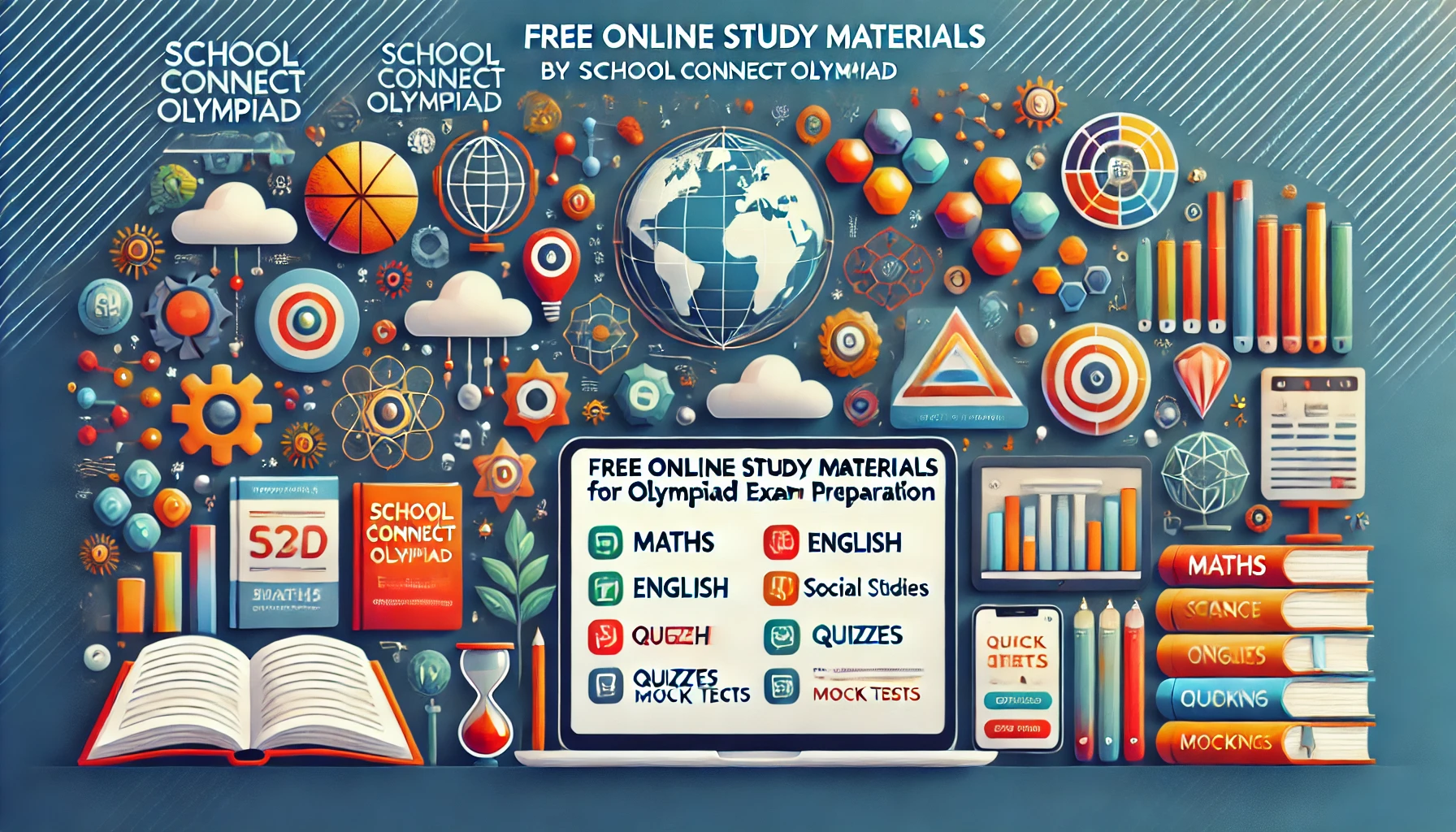
Find the next topic you need in a few clicks. Browse free class-wise learning materials, chapter-guided notes, linked educational videos, practice questions, sample papers and school syllabus resources. Start with your class, choose a subject, study one concept and practise it. These learning resources are separate from any optional paid Olympiad examination.

Browse learning resources by class
Choose your current school class to explore subject explanations, revision notes, practice articles and other available class-tagged pages in the School Connect learning library. The class links below open the site’s existing populated WordPress archives; each archive is a collection, not a guarantee that every subject has every chapter fully covered.
What to study at each stage
Classes 1–3: strong foundations
Reading confidence, everyday English, counting, shapes, basic addition and subtraction, observation of plants and animals, and simple patterns.
Classes 4–6: connect concepts
Fractions, multiplication and division, word problems, measurements, reading comprehension, basic scientific observations and fair comparisons.
Classes 7–9: reason and explain
Ratios, algebra, data handling, geometry, biology and physical science foundations, longer writing and structured problem solving.
Classes 10–12: prepare for advanced work
Subject-specific chapters, school examination preparation, applied mathematics, science analysis, stronger explanations and careful review of past questions.
Free subject-wise lessons and linked learning videos
School Connect’s official free Olympiad video resource page explains that learning videos support a range of subject topics. Start with the subject page, choose your class and topic, read the explanation, open a linked video if available and answer related questions. Some linked resources or account-dependent activities may have different access steps; the free learning programme should never be confused with an automatically free exam registration.
| Subject | Useful starting points | What to practise |
|---|---|---|
| Mathematics | Maths chapter and class guide | Number sense, operations, fractions, geometry and reasoning |
| Science | Science syllabus and class guide | Observation, measurement, life science, materials and energy |
| English | English syllabus and class guide | Vocabulary, grammar, reading comprehension and writing |
| Coding | Coding and algorithms guide | Sequences, logical thinking, loops and debugging |
| Artificial Intelligence | AI learning and subject overview | Data, examples, recognising patterns, fairness and safe use |
| Mental Ability | Reasoning and mental ability guide | Patterns, comparisons, classifications and logic |
| General Knowledge | General knowledge overview | Geography, environmental awareness and careful fact checking |
| Life Skills | Free life skills learning guide | Teamwork, decision making, ethics and sustainability |
Find useful syllabus guidance, textbook help and sample papers
Some School Connect articles follow Indian school topics such as CBSE and NCERT. These are useful for understanding or revising a chapter, but old archive posts may refer to an earlier year’s syllabus. Check your current teacher-prescribed textbooks, school board and the latest official syllabus before treating any archived article as today’s exam requirement.
- CBSE syllabus archive — explore the school’s older and newer syllabus articles; check current applicability.
- NCERT solutions archive — topic explanations and step-by-step solutions where available.
- Board examination resources — subject guidance and school exam preparation articles.
- NCERT official textbooks — verify the prescribed edition and exercise before practising.
- Free Mathematics Olympiad sample-paper hub — class-wise practice and answer-review guidance.
- Free learning materials and practice overview — explore linked topic resources; check each specific paper or test before assuming access.
- 2026 Science Olympiad syllabus overview PDF reference page — confirm the material and choose the download only if relevant.
- Class 1 English sample paper and explanations — an example of a verified archived sample set.
Your four-step learning method
- Step 1 — select one topic: begin with your current school class and the chapter prescribed by your teacher. Read the learning objective before studying.
- Step 2 — learn: read one explanation or school textbook section. Watch a suitable linked learning video, if offered, and summarise the concept in your own words.
- Step 3 — practise: solve three easy questions and two slightly harder questions without copying the solution. For a science activity, record what you observed and the units used.
- Step 4 — correct and repeat: check explanations, record why an answer was incorrect and revisit the topic the next day or later in the week.
Seven-day study planner you can copy
| Day | Suggested short study block | One useful outcome |
|---|---|---|
| Monday | Read the selected Maths or English chapter | Write three new facts or examples |
| Tuesday | Watch a linked explanatory lesson | Explain one idea aloud |
| Wednesday | Work five topic questions | Identify the first step that caused an error |
| Thursday | Read the next short subject section | Draw a diagram or concept map |
| Friday | Try three mixed questions and a short reading passage | Check clarity as well as correctness |
| Saturday | Do a safe home or classroom observation activity | Record evidence with dates and units |
| Sunday | Review mistakes and choose the next chapter | Prepare next week’s goal without overloading school time |
This timetable is a suggested example, not an official school schedule. Younger children may need shorter sessions; older students preparing for board exams should adjust the plan around their actual school timetable, rest and wellbeing.
20 original practice questions with simple worked answers
Use these short questions to check understanding before visiting more detailed chapters. They are newly written study exercises, not official SCO examination papers or current school-board questions. The grade groupings are illustrative; check your teacher’s actual syllabus before using the advanced examples.
Classes 1–3: foundations
Question 1. What is 12 + 9?
A. 21 B. 20 C. 22 D. 23
Correct answer: A. 21. 12 + 8 = 20, then add the remaining 1 to make 21.
Question 2. What follows 6, 9, 12, 15, 18 in a pattern?
A. 20 B. 21 C. 22 D. 24
Correct answer: B. 21. Each new number adds three. 18 + 3 = 21.
Question 3. Which of these is a living thing?
A. Rock B. Plastic cup C. Tree D. Wooden ruler
Correct answer: C. Tree. A tree grows, takes in water, and carries out life processes. The other objects do not.
Question 4. How many centimetres are in one metre?
A. 10 B. 50 C. 1,000 D. 100
Correct answer: D. 100. One metre contains 100 centimetres; a centimetre is one hundredth of a metre.
Question 5. Three cats have four legs each. How many legs altogether?
A. 12 B. 8 C. 9 D. 16
Correct answer: A. 12. 3 groups of 4 legs means 3 × 4 = 12.
Classes 4–6: applying concepts
Question 6. What is two thirds of 36?
A. 12 B. 24 C. 18 D. 30
Correct answer: B. 24. Divide 36 by 3 to get 12, then multiply by 2 to get 24.
Question 7. A rectangle has a length of 7 cm and width of 8 cm. Find the area.
A. 15 cm² B. 30 cm² C. 56 cm² D. 64 cm²
Correct answer: C. 56 cm². Area is length × width: 7 × 8 = 56 square centimetres.
Question 8. What process changes liquid water into water vapour?
A. Freezing B. Melting C. Condensation D. Evaporation
Correct answer: D. Evaporation. Evaporation changes liquid into gas, typically at its surface, without requiring boiling.
Question 9. What is the measure of a right angle?
A. 90° B. 45° C. 120° D. 180°
Correct answer: A. 90°. By definition a right angle measures exactly 90 degrees.
Question 10. Which experiment better compares the effect of light on identical plants?
A. Use different seeds and soil B. Keep water and soil the same; change only light C. Change light and water simultaneously D. Measure only one plant once
Correct answer: B. Keep water and soil the same; change only light. Hold other factors constant so differences are more plausibly linked to light exposure.
Classes 7–9: reasoning
Question 11. Solve 3x + 4 = 25.
A. 5 B. 6 C. 7 D. 8
Correct answer: C. 7. Subtract 4 to get 3x = 21, then divide by three: x = 7.
Question 12. A triangle has angles 55° and 65°. Find the third angle.
A. 50° B. 55° C. 65° D. 60°
Correct answer: D. 60°. Angles in a triangle total 180°. 180 − 55 − 65 = 60°.
Question 13. Find the mean of 5, 7, and 9.
A. 7 B. 8 C. 6 D. 21
Correct answer: A. 7. The sum is 21; divide by three values to get 7.
Question 14. A box has 3 red and 2 blue identical balls. Probability of choosing red?
A. 2/5 B. 3/5 C. 1/2 D. 2/3
Correct answer: B. 3/5. Three red outcomes among five equally likely balls: 3 ÷ 5 = 3/5.
Question 15. What happens to total mass in an ordinary chemical reaction in a closed system?
A. It always doubles B. It becomes zero C. It is conserved D. It always halves
Correct answer: C. It is conserved. Atoms are rearranged; mass is conserved in a closed system under ordinary chemistry conditions.
Classes 10–12: advanced examples
Question 16. Factorise x² − 7x + 12.
A. (x−1)(x−12) B. (x+3)(x+4) C. (x−2)(x−6) D. (x−3)(x−4)
Correct answer: D. (x−3)(x−4). −3 and −4 add to −7 and multiply to +12, so (x−3)(x−4).
Question 17. Differentiate f(x) = x² + 3x.
A. 2x + 3 B. x + 3 C. 2x² + 3 D. x² + 3
Correct answer: A. 2x + 3. Apply the power rule to x² to get 2x; the derivative of 3x is 3.
Question 18. A 0.2 kW appliance works for five hours. How much energy does it use?
A. 0.2 kWh B. 1 kWh C. 5 kWh D. 25 kWh
Correct answer: B. 1 kWh. Electrical energy = power × time = 0.2 kW × 5 hours = 1 kWh.
Question 19. What is the probability of rolling a 6 on one fair six-sided die?
A. 1/2 B. 1/3 C. 1/6 D. 1/12
Correct answer: C. 1/6. There is one favourable result out of six equally likely faces: 1/6.
Question 20. Two variables are correlated in a student survey. Which conclusion is safest?
A. One must cause the other B. All students behave the same C. Measurement error cannot occur D. Correlation alone does not establish causation
Correct answer: D. Correlation alone does not establish causation. An association can be affected by confounding factors; causation needs more evidence.
Three practical activities to learn by doing
Activity 1: measure leaves safely
Choose five fallen leaves from a safe place, measure their lengths in centimetres with a ruler, and record the results. Find the largest, smallest and average measurements. Compare leaves only when they belong to clearly described samples; never taste unknown plants or collect leaves from unsafe roadsides.
Activity 2: design a reading-comprehension question
Read a short age-appropriate story. Write one question about a stated fact, one question about the character’s reasons, and one question asking for evidence from the text. Share the answers with a parent or teacher, checking that each answer is supported by the reading.
Activity 3: make an algorithm without a computer
Write instructions for drawing a square on paper: draw one side, turn 90 degrees, and repeat until there are four equal sides. Ask another person to follow the exact steps. If the drawing fails, revise ambiguous instructions. This introduces sequencing and debugging without requiring paid software.
Frequently asked questions about free learning resources
Are School Connect chapter-wise learning materials free?
School Connect provides free chapter-wise learning guidance, linked videos and practice questions. These learning resources are different from separately registered Olympiad examinations.
Can students start without registering for an Olympiad exam?
Yes. Begin with the class archive and subject learning pages. A paid competition booking is not a prerequisite for browsing the educational content available there.
How do I find my class from 1 to 12?
Use the class buttons at the top of this page. Each button opens an existing WordPress archive containing articles tagged with that class.
Does every class archive contain every subject and every chapter?
Not necessarily. The archives have different numbers of posts and some chapters are still being expanded. Choose a specific article or the subject page for the resources currently available.
Where can I find free mathematics practice?
Start with the School Connect mathematics subject page and the class-wise mathematics sample-paper hub; then choose a topic and use the worked examples before trying a full paper.
Where can I study Science?
Use the School Connect Science class guide, topic articles and syllabus reference. For current school lessons, also follow the science textbook specified by your teacher.
Does School Connect provide English learning?
The English subject page contains class-wise syllabus and preparation routes. Reading comprehension, vocabulary, sentence construction and grammar benefit from regular practice.
Can I watch free learning videos?
Yes. The School Connect video resource page lists subject-linked learning videos. A particular chapter may link to an external video or require additional navigation.
Are there verified downloadable PDFs?
Some School Connect resources have downloadable or viewable documents, such as its 2026 Science syllabus overview and specific class sample papers. Availability must be checked on each actual document page.
Can I use older Olympiad papers for exam practice?
Yes, when they are correctly labelled, relevant and accurate. An archived sample paper is not the current live exam, and its year, organiser and answers should be checked.
How do I study for CBSE using this page?
Open the CBSE syllabus archive and NCERT solution category, then compare the actual topic with the latest syllabus and approved textbook for your class. Older archived blog posts may use earlier editions.
Are NCERT books available through official sources?
Yes. The NCERT official textbook portal provides prescribed textbooks. School Connect explanations may support study but do not replace the official source.
Is the free Coding or AI learning identical to current examination eligibility?
No. Learning concepts can be useful for younger classes, while a specific active Olympiad cycle may have narrower class eligibility. Verify the current published exam calendar before registering.
Do I need to buy a monthly learning subscription?
No. The chapter-wise learning materials, linked videos and practice questions described on this page are available as free study resources.
Are School Connect resources a substitute for a teacher?
No. Use them as supporting material alongside classroom teaching, local education standards, assignments and the school’s learning plan.
What should I do after a wrong practice answer?
Read the correct explanation, identify the step you missed, work a similar question without looking at the answer and revisit it later to confirm understanding.
Can teachers use the resource links in class?
Teachers can assign suitable public learning links, choose age-appropriate questions and verify current syllabus alignment. Follow the resource’s reuse and copyright terms for redistribution.
Are all videos available in both English and Hindi?
Do not assume every linked video has every language or caption option. Check the actual video for language, subtitles and suitability before assigning it.
How much should students practise each day?
Short, consistent age-appropriate sessions are usually more manageable than cramming. Start with one chapter and a few questions, then adjust around school work and rest.
What if I find a broken link or an outdated answer?
Use the official School Connect support or contact page to report the exact URL and the issue. Choose an alternative verified resource while the page is checked.
Find your next chapter and keep learning
For quick school study, choose your class above, open a topic and answer five questions before reading the next chapter. To explore additional material, visit free subject video lessons, the Maths sample-paper hub or the NCERT support archive. Independent Olympiad participation is optional: check the current SCO exam-date guide for available classes, dates and conditions before considering registration.