
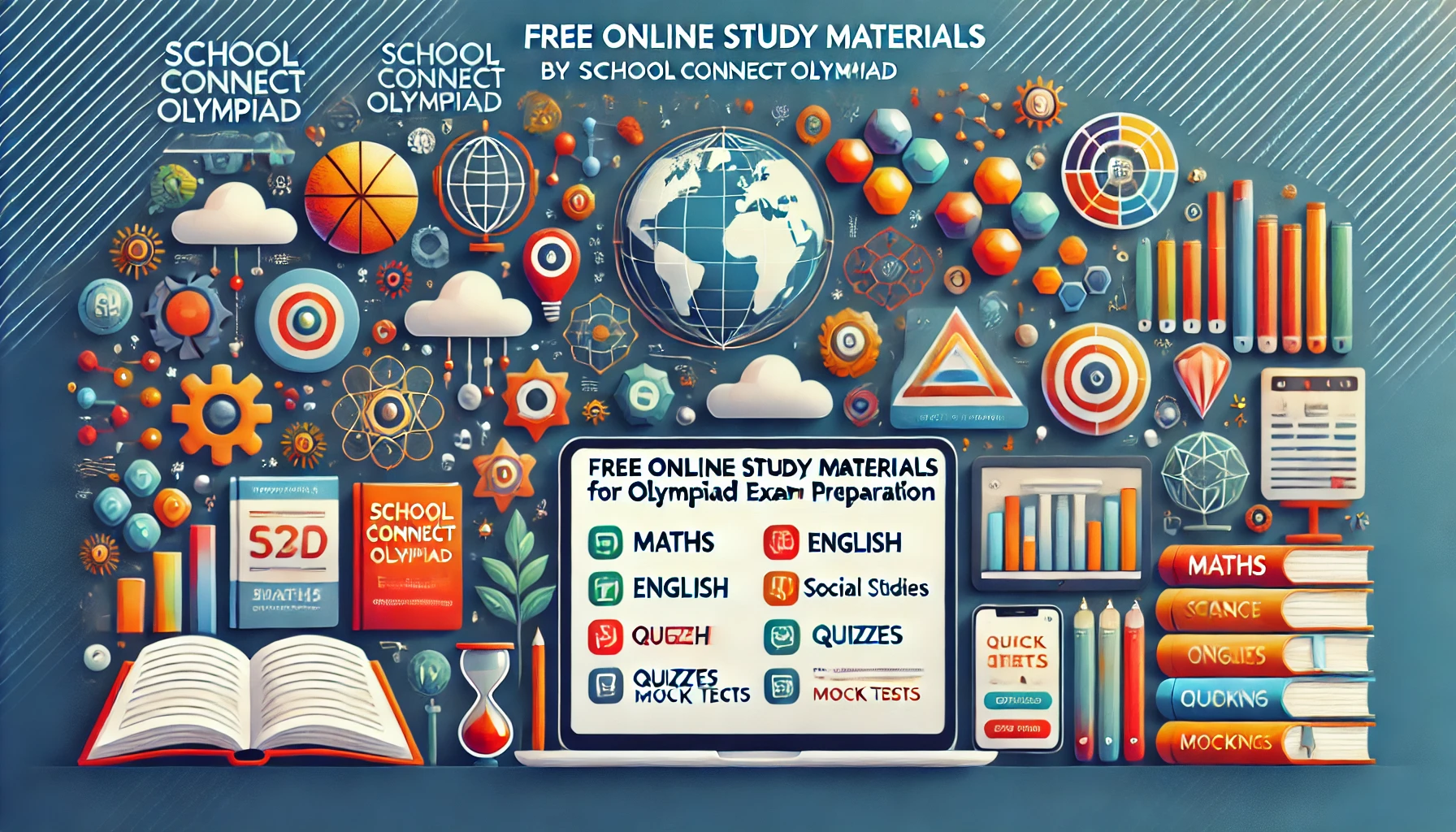
A useful Olympiad study session begins with a question: What do I want to learn, and how can I check that I understand? SCO provides free chapter-wise learning materials, linked educational videos and practice questions. These resources are continually updated and improved. This guide connects chapters, videos, syllabuses, sample-paper listings, answer keys and original worked examples to help families get started.
Start here: choose your class, subject and learning goal
The easiest path is to choose your actual school class first, then one subject: Maths, Science, English, Mental Ability, Coding, AI or another programme that is suitable for that grade. SCO’s subject list and reading and preparation hub can help you explore. The individual grade-and-subject pages show chapter lists and links to downloadable resources when they are available.
| Resource type | A good time to use it | What to check before relying on it |
|---|---|---|
| Chapter list or syllabus | Before studying or setting a weekly plan. | Correct class, subject and paper version; the resource may be publicly viewable. |
| Sample-paper landing page and PDF | After learning the main ideas; practise question style and layout. | Does the actual PDF open, and what edition and grade are printed on it? |
| Answer key | Only after completing suitable practice. | Match the paper and set; understand why an answer is correct. |
| Online mock test | When a student is ready for a practice sitting. | Chapter-wise practice questions are free. Check a separate timed examination or login requirement independently. |
| Video, report or learning dashboard | To revisit a missed concept or track improvement. | Linked chapter-wise educational videos are free. Check any separate examination-specific report independently. |
Public SCO resource library: useful links by class
The following are publicly viewable 2026 resource landing pages. Their on-page download buttons lead to the file offered for that grade and subject; not every document is newly written in 2026. Pick one row that matches your child and follow the same order every time: syllabus → sample questions → matching answer key.
| Class and subject | Syllabus | Sample paper | Answer key |
|---|---|---|---|
| Class 1 · English | 2026 syllabus | Sample Paper 1 | Answer key |
| Class 2 · Science | 2026 syllabus | Sample Paper 1 | Answer key |
| Class 3 · Maths | 2026 syllabus | Sample Paper 1 | Answer key |
| Class 6 · Maths | 2026 syllabus | Sample Paper 1 | Answer key |
Need a different class or subject? Open the SCO Olympiad subjects and choose your grade-specific page rather than using another child’s question set. For example, Class 1 English includes simple vocabulary, nouns and articles, while Class 6 Maths introduces more complex numerical reasoning. The best paper is one you are ready to learn from.
Free chapter-wise learning materials and how to use them
SCO provides free chapter-wise learning materials, linked educational videos and practice questions. These resources are continually updated and improved. Students can build their understanding through free lessons and questions without any learning purchase. Competition entry or a student-specific exam report, if offered, follows its own current instructions and should be checked separately.
Begin with SCO’s free class-wise learning materials and choose a chapter, linked educational video or practice questions. If you need examination-specific records, use the official student login and follow that particular event’s current instructions.
A note on sample-paper editions and past-paper labels
Some public PDF pages carry ‘2026’ in the resource title, but the linked document can identify a different set or academic year. For example, the Class 3 Maths Sample Paper 1 (2026) page links to a solved practice PDF labelled Set H, 2024–25. That paper can still help with Maths, but it should not be described as a newly administered 2026 contest paper.
Similarly, a resource called Class 2 Science Previous Year Paper 1 (2026) is described as past-paper-style practice by its publisher. Such a resource can be valuable for revision, but its title alone does not establish that it was an actual previous competition paper. Read the first page of each file before choosing it.
How to use any syllabus, sample paper and answer key
- 1. Read the chapter names. Pick two or three that feel familiar and one that needs more time. Parents can turn chapter headings into everyday objects, stories and short observations.
- 2. Try a small number of problems. Younger learners can answer orally or use counters. Older students can write the method and units before choosing a letter.
- 3. Compare the reasoning with the answer key. Check both the correct option and the logic. Different papers and sets may have different answers.
- 4. Keep a ‘try again’ notebook. Mark a question as ‘I need the idea’, ‘I read too quickly’ or ‘I made a calculation slip’. Explain how to fix it.
- 5. Repeat after a few days. Attempt a new but similar question. A corrected explanation is stronger evidence of learning than a remembered answer letter.
What makes a mock test useful?
A mock test can be a useful rehearsal, but its main purpose is to reveal what to learn next. If an account offers timed practice, start with one short set. For younger children, solve questions calmly before adding time pressure. For middle-school students, it helps to practise checking units, making rough diagrams and allocating a few minutes to review answers. A practice score is not an official Olympiad result, a confirmed Level 2 qualification or proof of improvement on its own.
| After a practice attempt | Ask yourself | Try next |
|---|---|---|
| I missed the meaning | Did I read what the question asked? | Underline the instruction and restate it in my own words. |
| I knew the topic but calculated incorrectly | Can I check the answer in another way? | Use inverse arithmetic, a drawing or estimation. |
| I guessed after running short of time | Did I start with the hardest question? | Try easier questions first and add time limits gradually. |
| I remembered an answer but could not explain it | Do I know the underlying idea? | Teach a smaller similar example to another person. |
Learn in pictures: examples from SCO’s platform
These images offer a visual introduction to SCO learning and study activities. Interfaces, login features and availability may differ from the screenshots shown; always use the live platform to check a current feature.

SCO Olympiad Online Learning Platform 
SCO Olympiad Online Learning Platform 
SCO Olympiad Online Learning Platform 
SCO Olympiad Online Learning Platform 
SCO Olympiad Online Learning Platform 
SCO Olympiad Online Learning Platform 
SCO Olympiad Online Learning Platform 
SCO Olympiad Online Learning Platform
20 original practice questions with friendly solutions
Here are twenty brand-new questions created for this guide. They cover Maths (1–8), Science (9–14), English (15–18) and reasoning (19–20). The suggested grade appears beside each question. Children should attempt only problems that suit their level; these are teaching exercises, not copied SCO examination questions and not proof of the difficulty of any official mock.
Question 1 (Maths · Grade 1). A child collects 14 shells and finds 9 more. How many shells are there?
A. 23 | B. 22 | C. 24 | D. 19
Answer: A — 23. Add the ones: 4 + 9 = 13. One ten plus the extra ten makes two tens, with three ones: 23.
Question 2 (Maths · Grade 2). There are 36 stickers. A child gives away 19. How many remain?
A. 27 | B. 17 | C. 16 | D. 55
Answer: B — 17. Subtract twenty from 36 to get 16, then add back one because 19 is one less than 20. The answer is 17.
Question 3 (Maths · Grade 3). Six boxes hold seven pencils each. How many pencils altogether?
A. 13 | B. 36 | C. 42 | D. 48
Answer: C — 42. Six equal groups of seven pencils make 6 × 7 = 42.
Question 4 (Maths · Grade 4). Three quarters of 20 counters are blue. How many blue counters are there?
A. 5 | B. 10 | C. 12 | D. 15
Answer: D — 15. Divide 20 by four to find a quarter: 5. Multiply by three quarters: 3 × 5 = 15.
Question 5 (Maths · Grade 5). A rectangle has sides 7 cm and 4 cm. What is its perimeter?
A. 22 cm | B. 28 cm | C. 11 cm | D. 44 cm
Answer: A — 22 cm. Perimeter is the distance around the rectangle: 7 + 4 + 7 + 4 = 22 cm.
Question 6 (Maths · Grade 6). What is 25% of 80?
A. 25 | B. 20 | C. 40 | D. 32
Answer: B — 20. Twenty-five per cent means one quarter. 80 ÷ 4 = 20.
Question 7 (Maths · Grade 7). Find x if 4x + 3 = 23.
A. 4 | B. 7 | C. 5 | D. 6
Answer: C — 5. Subtract 3 from both sides, giving 4x = 20. Divide by 4 to find x = 5.
Question 8 (Maths · Grade 8). A triangle has a base of 12 cm and a perpendicular height of 5 cm. What is its area?
A. 60 cm² | B. 17 cm² | C. 24 cm² | D. 30 cm²
Answer: D — 30 cm². Triangle area = one half × base × perpendicular height = 1/2 × 12 × 5 = 30 cm².
Science: observe and explain
Question 9 (Science · Grade 2). Which plant part usually takes in water from soil?
A. Roots | B. Petals | C. Flowers | D. Fruit
Answer: A — Roots. Roots absorb water from soil and help anchor a plant.
Question 10 (Science · Grade 3). Which small object is usually attracted by a magnet?
A. A wooden button | B. An iron paper clip | C. A glass bead | D. A rubber eraser
Answer: B — An iron paper clip. Iron is attracted to a magnet. A wooden button and ordinary rubber or glass items usually are not.
Question 11 (Science · Grade 4). What does an ice cube become when it melts?
A. Smoke | B. Salt | C. Liquid water | D. Sand
Answer: C — Liquid water. Melting changes solid water (ice) into liquid water. It is still made of water.
Question 12 (Science · Grade 5). To test whether sunlight affects a plant’s growth, what is most important?
A. Use different plant species | B. Change the soil and water at the same time | C. Measure one plant only once | D. Keep other conditions alike and change light exposure
Answer: D — Keep other conditions alike and change light exposure. A fair comparison changes sunlight deliberately while keeping other conditions as similar as possible.
Question 13 (Science · Grade 6). In a food chain with grass, rabbit and fox, which is the producer?
A. Grass | B. Rabbit | C. Fox | D. All three
Answer: A — Grass. Grass is a green plant that makes its own food using sunlight. The animals are consumers.
Question 14 (Science · Grade 7). A cyclist travels 90 metres in 15 seconds at constant speed. What is the speed?
A. 15 m/s | B. 6 m/s | C. 75 m/s | D. 1.5 m/s
Answer: B — 6 m/s. Speed = distance ÷ time = 90 ÷ 15 = 6 metres per second.
English: read the sentence carefully
Question 15 (English · Grade 1). Complete the sentence: ‘I ate ___ apple.’
A. a | B. thee | C. an | D. anys
Answer: C — an. Use ‘an’ before the vowel sound at the start of ‘apple’: ‘an apple’.
Question 16 (English · Grade 2). Which word means the opposite of ‘ancient’?
A. Old | B. Historic | C. Former | D. Modern
Answer: D — Modern. Ancient means very old; modern describes something of the present or relatively recent time.
Question 17 (English · Grade 3). Which punctuation mark correctly ends ‘Where is my pencil’?
A. ? | B. ! | C. ; | D. :
Answer: A — ?. The words ask a question, so a question mark is the suitable end mark.
Question 18 (English · Grade 4). Which sentence has correct subject–verb agreement?
A. The birds sings. | B. The birds sing. | C. The birds singing. | D. The birds is sing.
Answer: B — The birds sing.. The plural subject ‘birds’ takes the base present-tense verb ‘sing’.
Reasoning: find the rule
Question 19 (Reasoning · Grade 4). What number comes next: 3, 6, 12, 24, __?
A. 27 | B. 36 | C. 48 | D. 60
Answer: C — 48. The pattern doubles each time: 3, 6, 12, 24 and then 48.
Question 20 (Reasoning · Grade 6). All squares are rectangles. A blue tile is a square. What follows?
A. The tile has five sides | B. The tile must be a circle | C. The tile cannot have equal sides | D. The tile is also a rectangle
Answer: D — The tile is also a rectangle. A square has four right angles, so it meets the definition of a rectangle, and it also has four equal sides.
A four-week study plan for steady progress
| Week | Learning focus | A simple family or classroom activity |
|---|---|---|
| Week 1 — Find your level | Choose the appropriate subject syllabus and learn two key topics. | Make a short ‘things I know, things I want to learn’ list. |
| Week 2 — Understand examples | Use drawings, small Science observations or short reading activities. | Explain five questions aloud before looking at answers. |
| Week 3 — Learn from practice | Try one suitable public sample paper or an account mock that is actually available. | Check the matching answer key and write a useful correction note. |
| Week 4 — Revisit and grow | Try similar questions, take breaks and practise checking work. | Teach a family member one idea you understand better now. |
The goal is not to finish every possible resource. Class 1 students may enjoy five or ten minutes of discovery, while older students can practise for longer according to interest and readiness. Effective preparation makes room for questions, rest and confidence—not constant tests.
More useful preparation and subject links
- SCO reading and preparation resources — beginning points for independent study.
- Find SCO Olympiads and subjects — start with the right grade and subject.
- Maths Olympiad guidance — numerical learning and subject information.
- Science Olympiad guidance — observation and Science learning topics.
- English Olympiad guidance — reading, vocabulary and grammar.
- Class 1 Science explained questions — gentle early Science examples.
- Class 2 Maths explained questions — counting, number patterns and measurements.
- Class 3 Maths explained questions — stronger problem-solving foundations.
- Higher-level Maths and Science practice — challenging thinking with important Level 2 eligibility distinctions.
- Khan Academy and Code.org — complementary independent education resources.
Frequently asked questions about resources and access
Are all SCO Olympiad preparation materials free?
SCO provides free chapter-wise learning materials, linked educational videos and practice questions. These resources are continually updated and improved. Whether a specific online examination, certificate or competition report is available should be checked against the current exam notice; those features are distinct from freely accessible study materials.
Can I view a syllabus without signing in?
Yes, the public grade-and-subject pages and the linked 2026 syllabus landing pages can be opened without first signing in. The linked PDF itself should be opened and checked for suitability.
Can I download a public sample paper?
SCO has public 2026 sample-paper landing pages with a Download PDF control. For example, its Class 3 Maths Sample Paper 1 page links to a PDF that opened without an account during this review. Actual individual files, formats and access may vary.
Are 2026-labelled PDFs necessarily new 2026 examination papers?
No. For example, a 2026 Class 3 Maths sample-paper landing page opens a solved paper marked Set H, 2024–25. Treat the page year as the resource listing year unless the document itself establishes a different edition.
Are ‘previous year’ resources always authentic administered past examinations?
Not automatically. Some SCO pages explicitly describe them as past-paper-style practice. A title alone does not prove a file was used in a past examination.
What is the difference between a mock test and a sample paper?
A sample paper is a set of practice questions, often downloadable. A mock test may be an online timed session with answer submission and scoring. Neither automatically counts as a real Olympiad attempt.
How should a Class 1 child prepare?
Use short reading and observation activities, plenty of discussion, and a few suitable questions read aloud by an adult. A happy ten-minute lesson is better than stressful timed drills.
Where should Grades 6–8 students begin?
Start with the published syllabus for the chosen subject and grade. Review weak concepts, attempt a suitable sample paper, then check errors with worked answers before trying time-limited practice.
Does SCO provide answer keys?
Several grade-and-subject 2026 resource sets include separate answer-key landing pages. Use each matching answer key after trying the paper, not before.
Can I use SCO chapter-wise learning resources for free?
SCO provides free chapter-wise learning materials, linked educational videos and practice questions. These resources are continually updated and improved. A separate competition report or timed examination, if offered, should be checked using current event and account instructions.
Can students outside India access the resources?
Public pages can often be read from many locations, but availability of a language, downloadable file, paid service or official exam entry may vary. Confirm country and access conditions with the organiser.
Where can I find the next examination date?
Use SCO’s cycle-wise exam calendar, which lists WINTER 2027 dates in October–December 2026, then confirm an actual subject/class slot in registration. A date on an older subject page may already have passed.
Begin with curiosity, not a checklist
A useful preparation habit is simple: learn one concept, try one question, discuss why the answer works and revisit it later. Use the SCO class and subject listings to find a suitable public syllabus and sample resource. Families interested in taking a formal Olympiad can consult the current cycle calendar and registration details once they are ready, while checking the final availability and terms.




Leave a Reply