
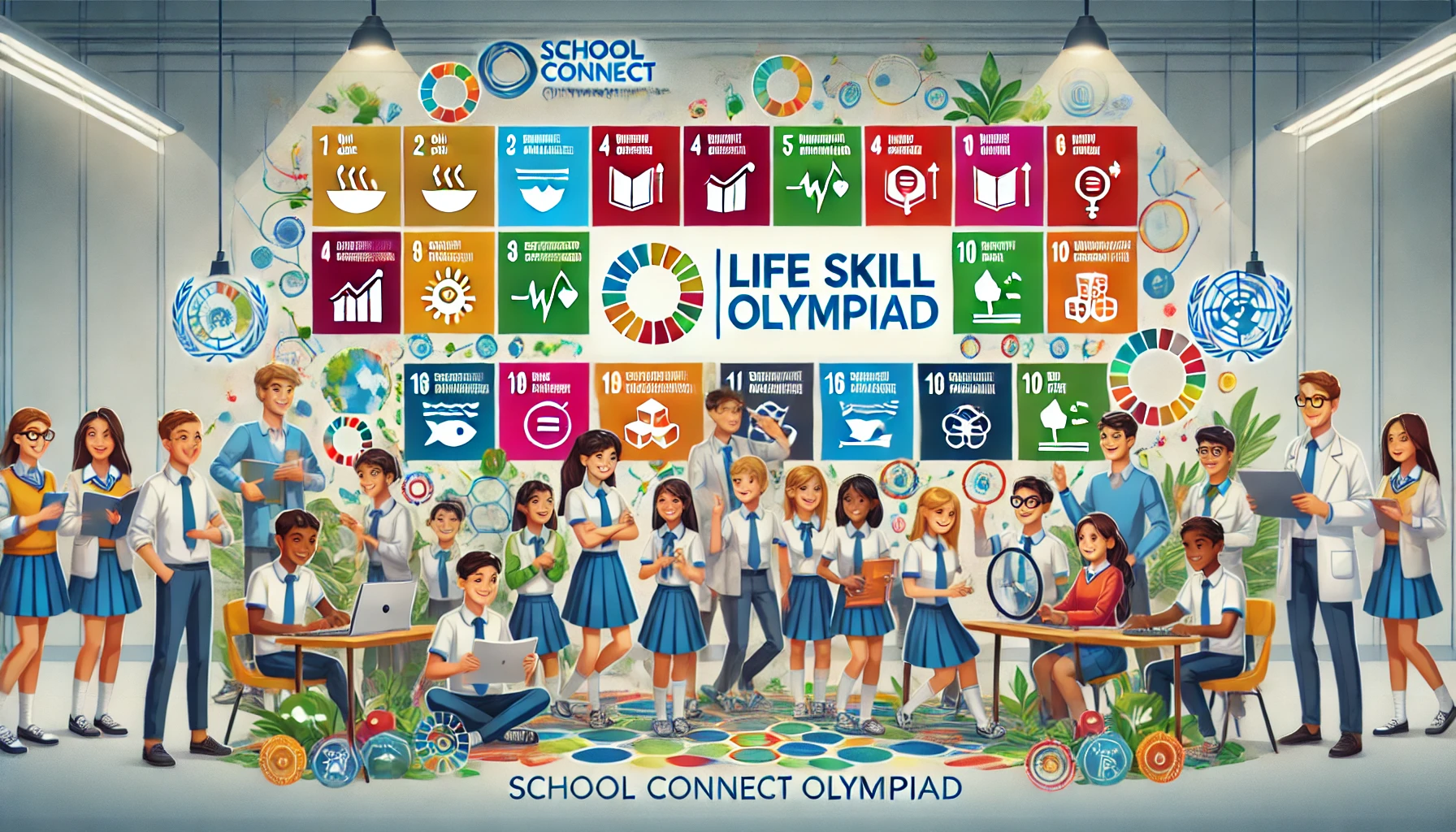
Life skills are the practical habits that help children communicate, make decisions, work with others and handle everyday challenges. The School Connect International Life Skills Olympiad offers age-based learning and an independent competition for Classes 1–12. This guide brings together the 2026 grade-wise syllabus routes, free chapter-linked learning, activities for different age groups, 20 original answered practice questions and sensible registration guidance.

What is the International Life Skills Olympiad?
School Connect Olympiad (SCO) organises its own Life Skills Olympiad. Its study themes include healthy habits, respect, communication, awareness of the environment, teamwork and ethical decision-making. These themes relate to the United Nations Sustainable Development Goals as educational ideas; this does not mean the United Nations, UNESCO or UNICEF organises, certifies or awards SCO examinations.
UNESCO explains social and emotional learning as recognising emotions, showing concern for others, building positive relationships and making responsible choices. The value of these skills comes from practising them in ordinary life, not solely from taking an examination.
Life Skills Olympiad syllabus: Classes 1–12
Start with the official Life Skills Olympiad overview and then select the student’s class. That overview groups the material into broad age bands, while the individual class pages list more specific chapters; those two levels of detail should not be treated as identical.
Classes 1–4: habits, kindness and understanding others
The Class 1 Life Skills learning page currently lists eight chapter groups: festivals and celebrations; places of worship; good habits; stories from Panchatantra and Jataka traditions; gratitude and appreciation; mentors; spirituality and five elements; and yoga and exercises. A teacher may use these chapters to build vocabulary and respectful discussion rather than asking children to follow any one personal belief.
- Good habits: practise washing hands, tidying a shared desk and making a short daily plan.
- Celebrations and communities: learn about different holidays and worship spaces with curiosity and respect.
- Stories and gratitude: discuss characters’ decisions and thank people who help us.
- Movement and self-awareness: practise safe, age-appropriate stretching with adult supervision, without forcing movements or treating this as medical advice.
Classes 5–8: decisions, teamwork and responsible technology
The broad SCO syllabus overview includes problem-solving, collaboration, digital literacy, health and sustainability for this age band. However, Class 5 and Class 8 have their own named chapter lists, including some topics on values and spirituality. Students should follow their actual class page instead of assuming every grade studies exactly the same five topics.
- Discuss ways to handle disagreements respectfully and share project responsibilities.
- Learn why passwords are private, why rumours should not be forwarded and when to ask a trusted adult for help.
- Plan a simple reusable-bottle count, a classroom water-saving habit or an evidence-based group project.
- Reflect on stories and ideas respectfully while checking factual claims with trustworthy evidence.
Classes 9–12: ethics, leadership and responsible citizenship
The broad Life Skills overview includes leadership, financial literacy, careers, sustainability and global citizenship. The Class 12 subject page also lists spirituality, cause and effect, youth contributions, human rights, inspirational quotations and science and mythology. These are the published class-page topics, so older students should consult the current class-specific syllabus before revising.
- Create a fictional budget and justify spending choices transparently.
- Practise respectful disagreement without attacking people or their identities.
- Analyse the difference between evidence-based scientific claims and cultural or philosophical narratives.
- Design a community project with a measurable goal, ethical data collection and a realistic review.
Free Life Skills learning resources and 2026 PDF status
School Connect offers free chapter-wise learning materials, linked educational videos and practice questions, which are continually updated. Students do not need a discontinued Learn, Grow or Compete subscription to use these free learning resources. Choose your class from the Life Skills subject hub to locate its learning chapters.
The following are official resource pages, not guaranteed direct PDF downloads. Some have a visible PDF download button; others currently say “Coming soon”. Check the button on the destination before relying on it for a paper, key or syllabus.
Classes 1–4 resource route
- Class 1 lessons and topics — the most reliable starting point for current free chapter learning.
- Class 1 Life Skills syllabus (2026) resource page — the PDF was labelled Coming soon when checked on 19 October 2026; this is not an active syllabus download.
Classes 5–8 resource route
- Class 5 topic and download directory — use its lessons while planning activities.
- Class 5 Life Skills sample-paper (2026) resource page — the page showed Coming soon, so it must not be advertised as an available file.
- Class 5 answer-key resource page — also displayed Coming soon when checked.
Classes 9–12 resource route
- Class 12 learning and resources — class-specific chapter headings and the related PDF directory.
- Class 12 syllabus 2026 resource page and Class 12 sample-paper resource page — their indexed pages show Download PDF; however the actual downloaded binary has not been independently checked here. Review the file itself before treating it as an authenticated question paper.
- General 2026 Life Skills exam guide resource page — a preparation overview; refer to the live page for its current downloadable-file state.
If a file is still pending, the chapter links and original problems on this page provide an immediate alternative. A resource title saying “Previous Year Paper (2026)” does not establish that it is an actual historically administered examination; check the document’s edition and provenance first.
Twenty original Life Skills Olympiad practice questions with answers
These are newly written learning examples across three age groups, not official SCO exam questions or archived PDF content. The correct response in a real-life situation can depend on context, so adults should use the explanations for discussion rather than treating every scenario as an absolute rule.
Classes 1–4 — original practice
Question 1. You see a classmate drop a pencil case. What is a kind first step?
A. Help pick up the pencils and return them B. Laugh and walk away C. Hide the pencils D. Tell everyone to ignore the student
Answer: A. Help pick up the pencils and return them. Helping respectfully shows kindness and responsibility.
Question 2. After playing outside, what should you do before eating?
A. Touch food with dirty hands B. Wash your hands with soap and water C. Skip every meal D. Put muddy hands on your clothes
Answer: B. Wash your hands with soap and water. Handwashing helps remove dirt and germs.
Question 3. A friend celebrates a different festival. What is a respectful response?
A. Say their celebration is wrong B. Refuse to listen C. Ask politely and respect their customs D. Make fun of their clothes
Answer: C. Ask politely and respect their customs. Curiosity and respect help us understand one another.
Question 4. Your teacher explains a new classroom rule. Which behaviour shows good listening?
A. Interrupt repeatedly B. Speak to another person C. Leave without asking D. Listen and ask a polite question if confused
Answer: D. Listen and ask a polite question if confused. Listening carefully and asking politely makes instructions clearer.
Question 5. Your friend looks upset after losing a game. What can you say?
A. Would you like to talk about it? B. You should never play again! C. It is funny when you cry. D. Everyone must agree with me.
Answer: A. Would you like to talk about it?. A calm question shows empathy and lets your friend choose whether to talk.
Question 6. A tap is left running in an empty classroom. What is a sensible action?
A. Leave it running all day B. Close it safely or tell a teacher C. Pour extra water onto the floor D. Ignore every water leak
Answer: B. Close it safely or tell a teacher. Closing a safe, accessible tap or telling an adult can save water.
Question 7. Someone helps you with a difficult task. Which response shows gratitude?
A. I will never ask for help B. Why did you help? C. Thank you for helping me D. Now do all my work
Answer: C. Thank you for helping me. A sincere thank-you acknowledges another person’s effort.
Question 8. During a supervised stretching activity, a movement hurts. What should you do?
A. Force yourself to continue B. Hide the pain C. Push a friend to copy it D. Stop and tell the supervising adult
Answer: D. Stop and tell the supervising adult. Stop if an activity is painful and ask an adult for help.
Classes 5–8 — original practice
Question 9. A new student is excluded from group work. What is the most helpful response?
A. Invite the student to join and distribute tasks fairly B. Pretend they are not there C. Assign them all the work D. Tell the group they cannot learn
Answer: A. Invite the student to join and distribute tasks fairly. Inclusion and fair roles support positive teamwork.
Question 10. An unfamiliar message asks for your school account password. What should you do?
A. Reply with the password B. Do not share it; report the message to a trusted adult or school IT C. Post the password publicly D. Forward the message to everyone
Answer: B. Do not share it; report the message to a trusted adult or school IT. Passwords are private; suspicious requests should be reported.
Question 11. A project group has two different ideas. Which approach shows good collaboration?
A. Make one student silent B. Let the loudest member decide alone C. Listen, compare evidence, and agree on a fair plan D. Stop all communication
Answer: C. Listen, compare evidence, and agree on a fair plan. Comparing reasons and making a shared plan resolves differences constructively.
Question 12. A class survey records 18 reusable bottles on Monday and 25 on Friday. How many more were recorded on Friday?
A. 3 B. 5 C. 6 D. 7
Answer: D. 7. Subtract 18 from 25: seven more bottles were recorded on Friday; the numbers are an invented classroom exercise.
A. Avoid forwarding it and seek help from a trusted adult if needed B. Forward it to many groups C. Add an insulting comment D. Publish private information
Answer: A. Avoid forwarding it and seek help from a trusted adult if needed. Avoid spreading unverified or hurtful claims; use respectful reporting.
Question 14. You have one hour for schoolwork and screen-free rest. Which plan shows good time management?
A. Keep changing tasks without starting B. Set a realistic study period and a rest break C. Study all night without rest D. Let every notification interrupt you
Answer: B. Set a realistic study period and a rest break. A manageable plan with breaks supports focus and balance.
Classes 9–12 — original practice
Question 15. A student council advertises a project as having measured benefits without collecting evidence. What is the ethical response?
A. Publish the claim as proven B. Invent a survey result C. Clearly identify expected benefits and collect evidence before making factual claims D. Copy another project’s data
Answer: C. Clearly identify expected benefits and collect evidence before making factual claims. Accurate reporting distinguishes predictions from measured results.
Question 16. A club receives ₹1,200 and spends ₹450 on supplies and ₹250 on travel. How much remains?
A. ₹300 B. ₹400 C. ₹450 D. ₹500
Answer: D. ₹500. Expenses total ₹700, leaving ₹1,200 − ₹700 = ₹500. This is a fictional budget example, not an SCO fee.
Question 17. You disagree respectfully with a classmate’s belief. What best protects everyone’s dignity?
A. Discuss evidence and ideas without insulting the person B. Attack their identity C. Stop them from speaking D. Spread rumours about them
Answer: A. Discuss evidence and ideas without insulting the person. Respectful disagreement addresses ideas without personal attacks.
A. Treat popularity as proof B. Look for reliable evidence and distinguish cultural stories from scientific tests C. Reject all cultural stories as worthless D. Assume both claims are scientifically verified
Answer: B. Look for reliable evidence and distinguish cultural stories from scientific tests. Cultural and spiritual stories can be studied respectfully while scientific claims require evidence.
Question 19. Your team discovers its recycling project missed a major source of waste. What should leaders do next?
A. Conceal the omission B. Blame a younger student C. Explain the limitation and revise the study D. Publish the original report as complete
Answer: C. Explain the limitation and revise the study. Transparent corrections support ethical leadership and better decisions.
Question 20. Two projects cost the same, but one meets the class’s stated goals better according to an agreed rubric. What is the strongest decision?
A. Select the most colourful poster B. Pick whichever is presented first C. Choose at random without review D. Compare the evidence against the rubric and document the choice
Answer: D. Compare the evidence against the rubric and document the choice. Shared criteria and recorded reasons make decisions more accountable.
A four-week Life Skills learning plan
- Week 1 — Notice: observe habits, emotions and helpful actions. Make a simple daily checklist suited to the learner’s age.
- Week 2 — Discuss: read a story or everyday scenario and ask which choice respects others.
- Week 3 — Practise: work on a small family or class project such as saving water, budgeting pretend money or checking information safely.
- Week 4 — Reflect: solve the original questions, explain one improved decision and revisit the official syllabus for the student’s class.
How to register for the current Life Skills Olympiad cycle
SCO’s subject page lists Classes 1–12, but individual subject and download pages may contain older calendar entries. In particular, the 18 October 2026 date shown on an SCO subject widget has already passed as of 19 October 2026. Do not assume a new exam slot, a uniform ₹300 or USD 12 fee, or a guaranteed award. Instead, check the current student registration page, school registration page and subject’s published rules and exam links for the precise cycle, class, assessment instructions, dates, fee, exam language, consent and eligibility.
A school coordinator should confirm these details before sharing any fee, dates or sample PDFs with families. International access should be checked for the student’s actual country and time zone rather than assumed from a list of countries.
Frequently asked questions
What is the Life Skills Olympiad?
It is School Connect’s independently organised subject competition and learning pathway for everyday communication, habits, values, decision-making and other age-based skills.
Which classes can study Life Skills through SCO?
The official Life Skills Olympiad overview covers Classes 1–12. Select the current class page to see grade-specific topics.
Are classes 1, 5 and 12 taught exactly the same topics?
No. The subject overview groups themes into age bands, but the class pages have their own chapter lists. Always use the matching class page.
Is SCO Life Skills an official United Nations or UNESCO examination?
No. Sustainable Development Goals and UNESCO education ideas are useful educational references; they do not establish UN or UNESCO sponsorship of the SCO exam.
Is chapter-wise Life Skills learning free?
School Connect offers free chapter-linked learning resources, educational videos and practice questions. Their content is being updated over time.
Is the Class 1 Life Skills syllabus PDF currently downloadable?
Its 2026 PDF resource page displayed ‘Coming soon’ when checked on 19 October 2026, so rely on the active class topics until a genuine download is available.
Can I download the Class 5 sample and answer key?
Those 2026 resource pages currently displayed ‘Coming soon’. Use the Class 5 subject lessons and this original practice instead.
Is the Class 12 2026 sample-paper PDF verified?
Enjoy exploring the Life Skills learning resources and available worksheets. When opening a downloadable activity, check its class, topic and instructions so you can choose practice that suits your learning goals.
Are these twenty practice questions official past papers?
No. They are original, age-labelled exercises with suggested explanations and are not presented as previously administered papers.
How can younger children practise emotional skills?
Use stories, simple gratitude activities, healthy habits and respectful conversations. Parents can read the question aloud and discuss alternatives.
Is registration priced at ₹300 or USD 12 for everyone?
Do not use that outdated blanket figure. Check the live official registration page for the fee that applies to the current class, subject, location and exam cycle.
Does participation guarantee medals or scholarships?
No. Any recognition depends on the current organiser rules, eligibility and actual outcomes. Preparation itself can support useful everyday learning.
Keep learning with School Connect
Start with the Life Skills subject page, select the correct class and practise a small, realistic habit today. Parents and teachers can also explore the free SCO learning-materials guide and other country and subject learning guides without assuming any resource is available as a downloadable PDF until its actual download opens.







Leave a Reply