
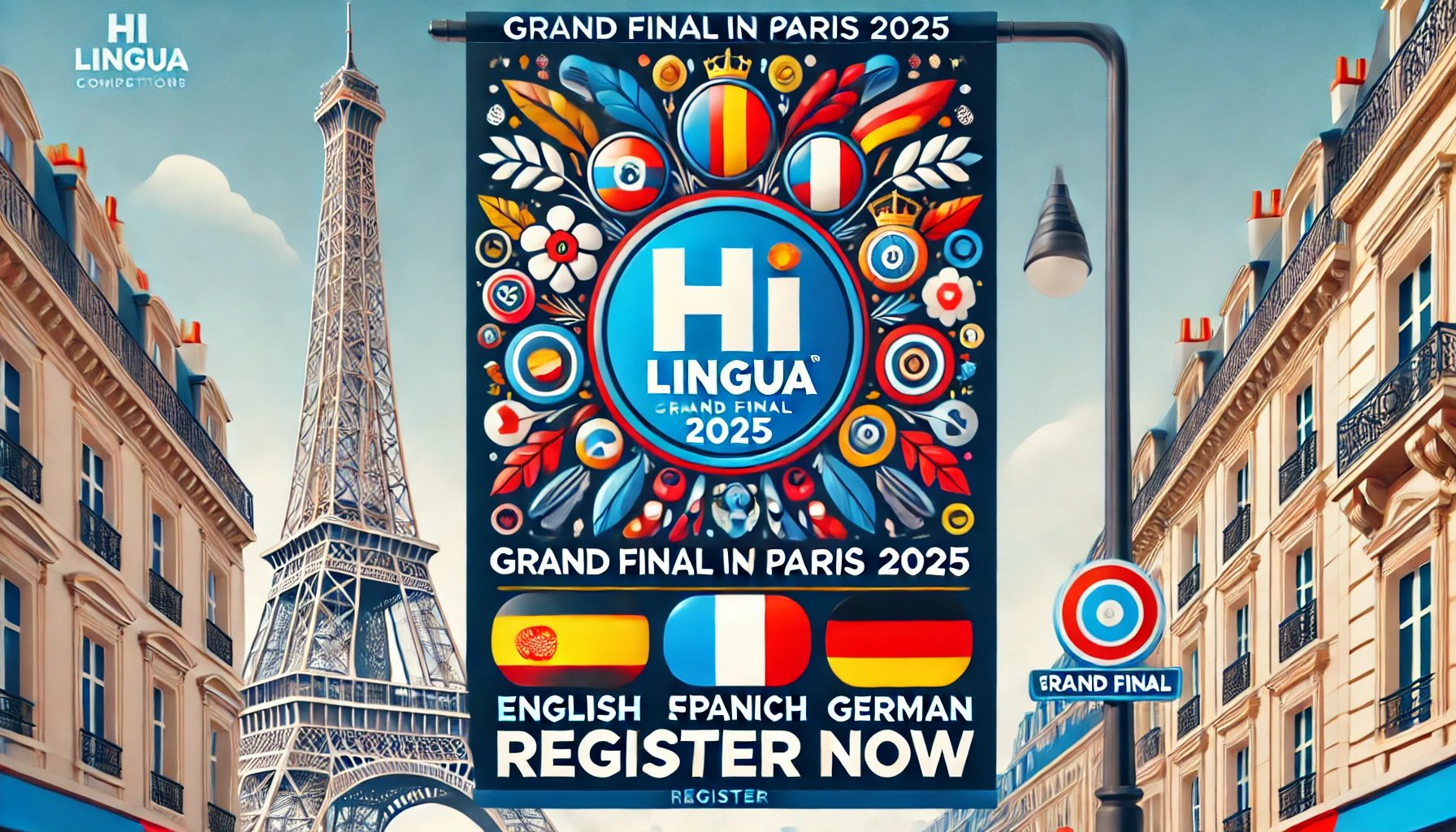
Hi-Lingua Language Competition: English, Spanish, French and German
Learning another language gives students new ways to communicate, understand stories and explore cultures. The Hi-Lingua Language Competition offers school students the chance to test their skills in English, Spanish, French or German and improve through reading, grammar, vocabulary and speaking practice.
Explore the current 2026–27 Hi-Lingua competition calendar, language choices, eligibility, registration steps and sixteen original practice questions with explanations. This guide also includes learning activities for students, parents and teachers.
Hi-Lingua is organised by Main Team Organisation GmbH. The official Hi-Lingua website provides the competition’s current registration, examination and language resources.

Hi-Lingua Competition Dates: 2026–2027
The official Hi-Lingua calendar lists the following examination stages:
| Stage | Date |
|---|---|
| Semi-final — first option | 7 November 2026 |
| Semi-final — second option | 23 January 2027 |
| Final — speaking and essay | 6–7 February 2027 |
| Grand final — Barcelona, Spain | April 2027 |
Check competition announcements for any changes to dates, venues or instructions.
Eligibility and Four Language Choices
The participation conditions cover students in Grades 3–11, grouped as Grades 3–5, 6–8 and 9–11. Students choose a foreign-language category rather than their native language.
| Language | Preparation topics | Practice idea |
|---|---|---|
| English | Vocabulary, grammar, reading | Explain the meaning of a short paragraph |
| Spanish | Greetings, verb forms, conversations | Describe your school day in Spanish |
| French | Common expressions, listening, verbs | Read a short dialogue aloud |
| German | Word order, sentence structure, verbs | Practise a conversation about travel |
Registration and Preparation Resources
- Choose a language: review the official language topic guide and eligibility conditions.
- Open registration: use the official Hi-Lingua registration page for the current student or teacher pathway.
- Review payment: the fees policy lists €25 per language category for each semi-final attempt. Each language and attempt may have a separate fee.
- Check exam requirements: follow the exam conditions for your session, including camera and device instructions.
- Practise: use the official language past-papers area and the preparation questions below.
Teachers can consult the school collaboration information for any available group arrangements.
16 Language Practice Questions with Answers
Choose the language you are studying. Answer each question yourself before checking the explanation, then try to use the same vocabulary or grammar in a new sentence.
English Practice
Question 1. She ___ to school every day.
A. goes | B. go | C. going | D. gone
Answer: A. goes. ‘Goes’ agrees with the singular subject ‘she’ in the present simple tense.
Question 2. Which word is closest in meaning to ‘brief’?
A. difficult | B. short | C. silent | D. careless
Answer: B. short. ‘Brief’ means short in time or length.
Question 3. If I had studied more, I ___ passed.
A. will have | B. had | C. would have | D. would
Answer: C. would have. The third conditional uses ‘would have’ and a past participle.
Question 4. Neither of the books ___ mine.
A. are | B. were | C. be | D. is
Answer: D. is. In formal written English, ‘neither’ takes a singular verb.
Spanish Practice
Question 5. What does ‘Buenos días’ mean?
A. Good morning | B. Good evening | C. Good night | D. Goodbye
Answer: A. Good morning. ‘Buenos días’ is a morning greeting.
Question 6. Complete: ‘Yo ___ estudiante.’
A. es | B. soy | C. eres | D. somos
Answer: B. soy. ‘Soy’ is the first-person singular of ‘ser’ (I am).
Question 7. Complete: ‘Nosotros ___ a la escuela.’
A. voy | B. van | C. vamos | D. vais
Answer: C. vamos. ‘Vamos’ agrees with ‘nosotros’ (we).
Question 8. Complete: ‘Ayer yo ___ una carta.’
A. escribes | B. escribir | C. escribo | D. escribí
Answer: D. escribí. ‘Ayer’ is yesterday; ‘escribí’ is the first-person preterite.
French Practice
Question 9. What does ‘Bonjour’ mean?
A. Hello / good day | B. Good night | C. Thank you | D. Goodbye
Answer: A. Hello / good day. ‘Bonjour’ is a daytime greeting.
Question 10. Complete: ‘Je ___ français.’
A. parles | B. parle | C. parlons | D. parlez
Answer: B. parle. ‘Je parle’ means ‘I speak’.
Question 11. Complete: ‘Nous ___ au musée demain.’
A. va | B. allez | C. allons | D. vont
Answer: C. allons. ‘Allons’ is the first-person plural form of ‘aller’.
Question 12. Complete: ‘Hier, elle ___ un livre.’
A. lit | B. lire | C. lira | D. a lu
Answer: D. a lu. ‘A lu’ is the passé composé for a completed action yesterday.
German Practice
Question 13. What does ‘Danke’ mean?
A. Thank you | B. Hello | C. Please | D. Goodbye
Answer: A. Thank you. ‘Danke’ is used to express thanks.
Question 14. Complete: ‘Ich ___ aus Indien.’
A. kommst | B. komme | C. kommt | D. kommen
Answer: B. komme. With ‘ich’, the correct form of ‘kommen’ is ‘komme’.
Question 15. Complete: ‘Wir ___ Deutsch.’
A. lernt | B. lerne | C. lernen | D. lernst
Answer: C. lernen. The plural subject ‘wir’ uses ‘lernen’.
Question 16. Complete: ‘Gestern habe ich ein Buch ___.’
A. lesen | B. liest | C. las | D. gelesen
Answer: D. gelesen. The past participle of ‘lesen’ is ‘gelesen’.
Two-Week Language Study Plan
| Days | Study activity |
|---|---|
| 1–3 | Practise greetings, everyday vocabulary and introductions |
| 4–6 | Work on present-tense verbs and short reading passages |
| 7–9 | Listen, speak aloud and use simple conversations |
| 10–12 | Attempt mixed grammar and vocabulary questions |
| 13–14 | Write a short paragraph and practise speaking with a partner |
Ideas for Students, Parents and Teachers
Choose a topic such as family, food, school or travel from the Hi-Lingua subject list. Write five new words, make two sentences and practise a short conversation. Teachers can use role-play and pair work to help students become more confident speakers.
For additional English study exercises, explore our class-wise English and Olympiad practice guide.
Frequently Asked Questions
Which languages does Hi-Lingua offer?
English, Spanish, French and German.
Which grades can join?
The general conditions list Grades 3–11, grouped into three learning stages.
Can I compete in my native language?
Hi-Lingua is for learners of foreign languages. Check the organiser’s language eligibility rules before selecting a category.
When are the next examination rounds?
The current calendar lists semi-final options on 7 November 2026 and 23 January 2027.
Where is the grand final planned?
The official calendar lists Barcelona, Spain, in April 2027.
Where can I see the exam fee?
Read the official payment policy and review the price shown for your selected language category.
How can I practise the four languages?
Use the sixteen questions above, the official past papers and regular vocabulary, reading and speaking activities.
Where do students register?
Start with official Hi-Lingua registration and follow the current portal instructions.
Keep practising: Choose four questions, explain the correct answers and write a short dialogue using words from the language you are learning.
Hi-Lingua Registration Guidance PDFs
The following downloadable guides can help students and teachers understand account setup, registration and payments. For your current exam session, follow the instructions shown in the official registration portal.
Student Payment Guidance
Use the Hi-Lingua payment policy and your registration account to confirm the accepted method and amount for your chosen language.
Teacher Payment Guidance
Teachers supporting several learners can review the school collaboration information and payment options for the chosen competition cycle.
Student Registration with an ID and Reference Code
Students who receive an ID and reference code from their teacher can use the following guide with the current registration portal.
Teacher Registration
Teachers can create an account through the organiser’s current registration pathway and coordinate their learners’ preparation.
Hi-Lingua 2025 Language Posters
Explore the posters for the 2025 language competition in English, French and German. Dates shown on those posters belong to the 2025 edition. For upcoming sessions, check the current Hi-Lingua calendar.






Leave a Reply