
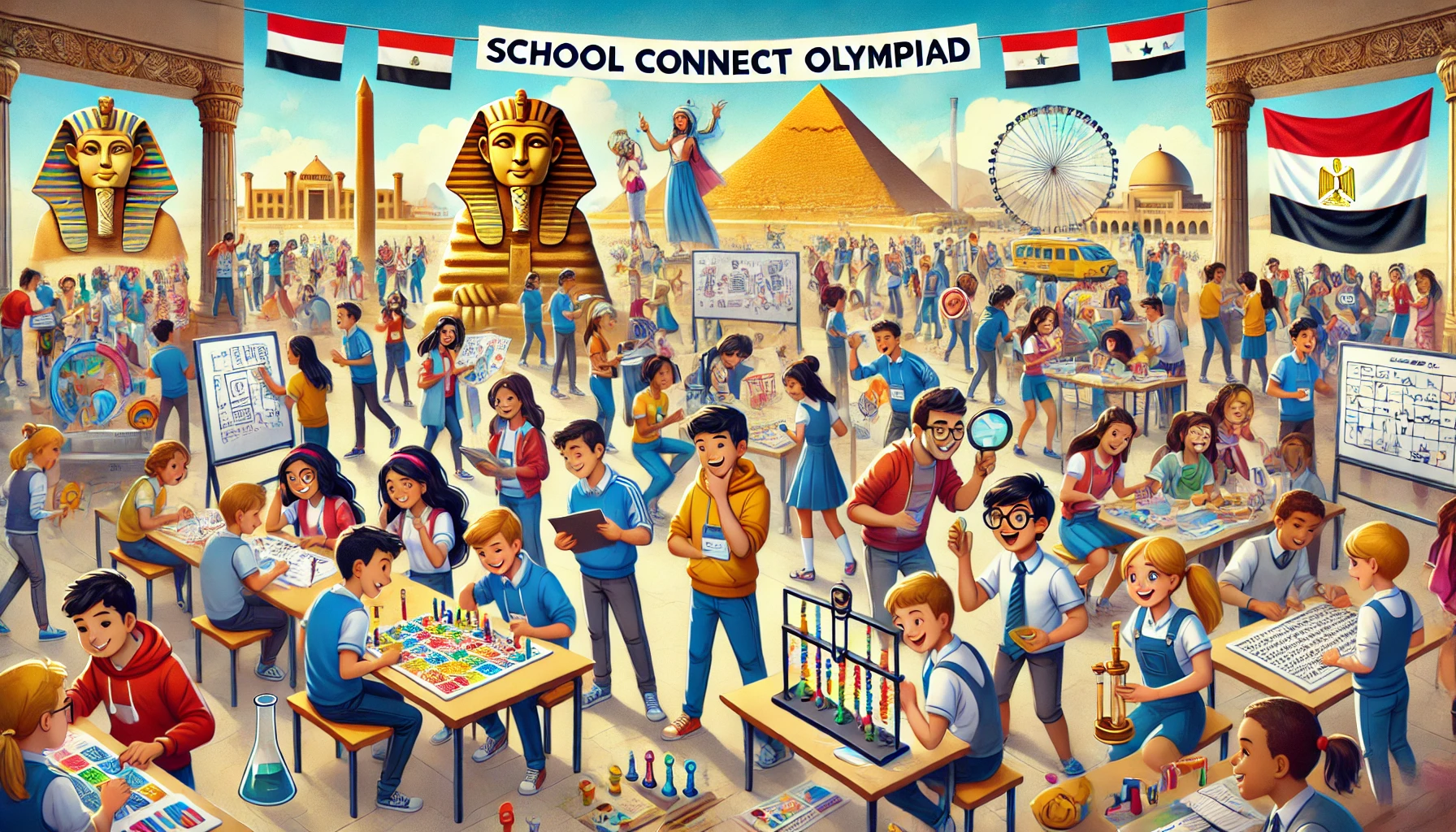
Olympiad Preparation in Egypt: A Practical Guide for Students and Schools
Students in Egypt can explore School Connect Olympiad (SCO) as an additional opportunity to practise mathematics, science, English, coding and problem-solving. SCO lists Egypt among the countries served by its international Olympiad registration programme. Families should choose a suitable subject and grade level, check the current examination schedule, and review the registration and award conditions before entering.
This guide explains how Egyptian students can prepare, how schools can support learners, what to check before registering and how to try 16 free practice questions with worked answers directly on this page. It is useful for families in Cairo, Alexandria, Giza and elsewhere in Egypt, as well as students in Egyptian and international schools.
Start with the SCO Olympiad subjects, exam dates and official student registration page.

Which Olympiad subjects can students in Egypt explore?
SCO offers international subject pathways for school learners, with the exact eligible grades differing by subject. Mathematics, Science and English are useful starting points; students may also consider coding, artificial intelligence, mental ability, finance and life skills when those options suit their grade and interests. Review the current subject and grade list before choosing.
Think of an Olympiad as an additional academic challenge, not a replacement for Egypt’s school curriculum, term examinations or the national secondary-school assessment. The Egyptian Ministry of Education’s textbook portal is the appropriate reference for the relevant Egyptian school syllabus. A student following an international curriculum should also use their own school’s books and assessment guidance.
Choose a suitable preparation level
| Learning stage | Helpful preparation | Try first |
|---|---|---|
| Early primary (approx. Grades 1–3) | Counting, operations, shapes, short reading passages | Simple number patterns and vocabulary questions |
| Upper primary (approx. Grades 4–6) | Fractions, measurement, scientific observations and comprehension | Worked fraction problems and elementary experiments |
| Lower secondary (approx. Grades 7–9) | Algebra, geometry, data, physical science and reading logic | Multi-step word problems and explanations |
| Senior secondary (approx. Grades 10–12) | Algebra, functions, advanced sciences and analytical reasoning | Topic-specific challenges and revision questions |
These are broad study stages, not a claim that Egyptian school-year names are always equivalent to international grade labels. Match the learner’s actual class and the organiser’s eligibility rules before registration.
How students and schools in Egypt can register
- Check subject and grade: Choose a suitable SCO Olympiad on the official Olympiad overview. Different subjects may have different eligible grades.
- Check the examination date: Review the current exam calendar and choose an available session that does not conflict with school assessments.
- Review rules and fees: On the official registration form, confirm Egypt as the country, the chosen subject, the total displayed fee, currency and accepted payment method before submitting payment.
- Complete correct student information: Enter the student’s name, grade, school, city, country and contact email accurately. Parents or schools should supervise younger children’s information.
- Save the confirmation: Keep any registration receipt, instructions, exam access information and chosen date together for exam day.
- Prepare with the syllabus: Use the current SCO topic material and practise with questions that have clear explanations rather than memorising options.
Registration availability, fees, currencies, exam windows and technical arrangements can change. The current official checkout and exam-calendar pages take precedence over older blog articles.
What should parents know about certificates and awards?
SCO publishes rules for digital participation and merit certificates, digital medals or badges, performance reports and eligible topper recognition. A certificate or award depends on the applicable programme, participation and verification conditions; it is not an automatic university admission credential.
Individual students should not expect cash scholarships from participation. SCO’s published policy distinguishes digital student recognition from institutional cash awards, which apply only to eligible schools or institutions under specific conditions. Read the current SCO awards and certificate rules for the actual conditions. View awards and verification information.
16 free Olympiad-style questions for students in Egypt
Start at your own level. These are original learning examples created for practice, with explanations that help learners practise each concept. Each question includes four options and a solution immediately below. Teachers can select an appropriate group for a classroom activity.
Grades 1–3: build foundations
Question 1. What is 48 + 27?
A. 65 | B. 75 | C. 85 | D. 95
Answer: B. 75. Add tens and ones: 48 + 20 = 68; add 7 more to get 75.
Question 2. What comes next in the pattern 5, 10, 15, 20, __?
A. 21 | B. 24 | C. 25 | D. 30
Answer: C. 25. The pattern increases by 5 each time, so 20 + 5 = 25.
Question 3. Which is a source of the light green plants use for photosynthesis?
A. The Sun | B. Dry sand | C. A stone | D. A plastic ruler
Answer: A. The Sun. Sunlight supplies energy for photosynthesis. Plants also need other things, including water and carbon dioxide.
Question 4. Choose the sentence with correct grammar.
A. She have a pencil. | B. She has a pencil. | C. She having a pencil. | D. She has an pencils.
Answer: B. She has a pencil.. The singular subject ‘She’ takes ‘has’, and ‘a pencil’ is the correct singular noun phrase.
Grades 4–6: improve problem-solving
Question 5. Calculate 3/4 + 1/8.
A. 4/12 | B. 5/8 | C. 7/8 | D. 1
Answer: C. 7/8. Convert 3/4 to 6/8. Add 1/8 to get 7/8.
Question 6. A rectangular floor measures 12 m by 7 m. What is its area?
A. 19 sq m | B. 38 sq m | C. 84 sq m | D. 96 sq m
Answer: C. 84 sq m. Area = length × width = 12 × 7 = 84 square metres.
Question 7. Which process changes liquid water into water vapour at the surface?
A. Freezing | B. Condensation | C. Evaporation | D. Melting
Answer: C. Evaporation. Evaporation changes liquid to gas from the surface, even below boiling temperature.
Question 8. Which word is closest in meaning to ‘rapid’?
A. Slow | B. Quick | C. Heavy | D. Bright
Answer: B. Quick. Rapid means happening fast; ‘quick’ is the best synonym.
Grades 7–9: develop reasoning
Question 9. Solve 3x + 5 = 26.
A. 5 | B. 6 | C. 7 | D. 8
Answer: C. 7. Subtract 5 from both sides to get 3x = 21, then divide by 3: x = 7.
Question 10. A right triangle has shorter sides of 6 cm and 8 cm. Find its hypotenuse.
A. 9 cm | B. 10 cm | C. 12 cm | D. 14 cm
Answer: B. 10 cm. Pythagoras gives √(6² + 8²) = √(36+64) = √100 = 10 cm.
Question 11. An aqueous solution has pH 4. How is it usually described?
A. Acidic | B. Neutral | C. Basic | D. Pure water
Answer: A. Acidic. A pH below 7 indicates an acidic aqueous solution; pH 7 is neutral under usual classroom conditions.
Question 12. Which sentence uses a metaphor?
A. The classroom was a zoo. | B. She walked quickly. | C. The sky is blue. | D. He carried a bag.
Answer: A. The classroom was a zoo.. Calling the classroom ‘a zoo’ is a metaphor expressing that it was very noisy or disorderly.
Grades 10–12: explore advanced problems
Question 13. What are the roots of x² − 5x + 6 = 0?
A. 1 and 6 | B. 2 and 3 | C. −2 and −3 | D. 3 and 5
Answer: B. 2 and 3. Factor: (x − 2)(x − 3) = 0. Therefore x = 2 or x = 3.
Question 14. For y = x³, what is the gradient of the tangent at x = 2?
A. 6 | B. 8 | C. 12 | D. 16
Answer: C. 12. Differentiate: dy/dx = 3x². At x = 2, the slope is 3 × 4 = 12.
Question 15. A 2 kg object accelerates at 3 m/s². What is the net force?
A. 1 N | B. 5 N | C. 6 N | D. 9 N
Answer: C. 6 N. Newton’s second law gives F = ma = 2 × 3 = 6 newtons.
Question 16. A fair coin is tossed twice. What is the probability of exactly one head?
A. 1/4 | B. 1/2 | C. 3/4 | D. 1
Answer: B. 1/2. Possible outcomes are HH, HT, TH, TT. Two of four outcomes have exactly one head, so probability = 2/4 = 1/2.
A two-week preparation plan for families
| When | What to do | Why it helps |
|---|---|---|
| Days 1–3 | Read the subject syllabus and try a small diagnostic set | Identify which concepts need explanation |
| Days 4–6 | Practise two or three weaker topics with worked examples | Build understanding instead of memorising answer keys |
| Days 7–9 | Mix topics and explain solutions aloud or in writing | Improve question reading and reasoning |
| Days 10–12 | Try a suitable timed practice session and review errors | Improve pacing after concepts are secure |
| Days 13–14 | Review notes, verify exam access and take adequate rest | Reduce avoidable mistakes on exam day |
Useful resources for Egyptian students and schools
- SCO Olympiad subjects — compare Maths, Science, English and other subjects
- SCO exam dates — choose the current academic cycle and date
- SCO registration — review grade, subject, fee and participation details
- SCO awards policy — digital certificate and award eligibility
- Egypt’s Ministry of Education textbook portal — refer to current Egyptian school learning materials
- Class 9 Maths questions with worked solutions — an additional guided practice page for older students
Common questions from families in Egypt
Can a student studying in Egypt explore School Connect Olympiad?
Yes. Egypt appears among the countries in SCO’s international participation network. Review the official registration page to confirm the specific student’s grade, subject and registration options.
Is School Connect Olympiad a ministry examination in Egypt?
No. It is a separate academic Olympiad programme. It does not replace Egyptian ministry examinations or a school’s own assessments.
Does the Olympiad follow the Egyptian national curriculum exactly?
Do not assume exact equivalence. Compare SCO’s published subject syllabus with the current Egyptian textbooks or your international school’s programme.
Must students be fluent in English?
Check the language and accessibility options for the chosen subject and exam session before registering. This guide is written in English; families can explain the examples in Arabic while learning the mathematical or scientific ideas.
Are Olympiad scholarships guaranteed?
No. Read the official awards policy before forming expectations. SCO describes digital recognition for individual students and conditional institutional cash awards for eligible schools, not guaranteed personal scholarships.
Do students receive a certificate automatically?
Digital participation and achievement certificates depend on SCO’s published terms, valid participation and any required checks. Not every student receives a medal or merit award.
Can schools coordinate participation?
SCO offers a school participation route. Teachers can help students choose appropriate subject levels, prepare from approved resources and communicate current dates and requirements to parents.
How much time should students spend on practice?
Start with manageable sessions and review mistakes carefully. Study habits should fit the student’s age, school schedule and comfort, not a rigid daily target.
Arabic–English study vocabulary
| English term | Arabic |
|---|---|
| Olympiad examination | امتحان الأولمبياد |
| Registration | التسجيل |
| Syllabus | المنهج الدراسي |
| Practice questions | أسئلة تدريبية |
| Worked solutions | حلول مشروحة |
| Digital certificate | شهادة رقمية |
Choose an appropriate topic, try the practice questions above and review the current SCO registration instructions when you are ready to participate.





Leave a Reply